

Source: John schnobrich/FlPc9 VocJ4 via Unsplash.
As organizations expand AI use, control over execution, governance and liability is becoming the key competitive battleground. Fragmentation not only complicates architecture but also weakens consistent policy enforcement across systems. The governance of intelligence, authority and execution must be consolidated into a coherent platform layer, according to Chris Marsh, research director at 451 Research from S&P Global Energy Horizons.
While no vendor yet delivers a complete solution, these are the six areas that define the core opportunity set for a mature system‑of‑delivery platform: enterprise intelligence, context coordination, decision authority, decision provenance, commitment system and execution resilience.
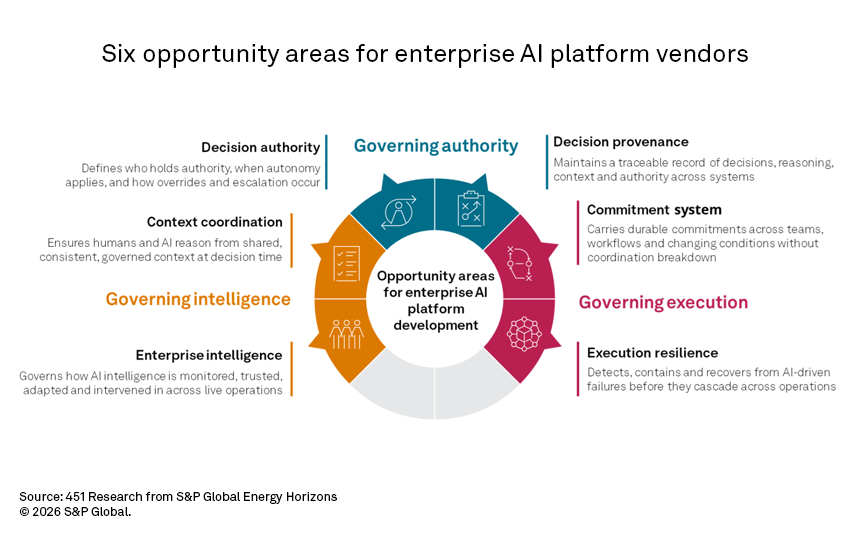
Enterprise intelligence
As AI automates decisions in core workflows, the quality of its outputs directly shapes organizations’ outcomes. However, it remains difficult to measure in business terms, creating a disconnect between technical metrics and executive accountability.
A new layer of enterprise intelligence is needed—one that makes AI observable, governable and adaptable in real-time. It must provide business-relevant assurance beyond machine learning operations by making the system’s reliability visible, detecting performance degradation and enabling controlled intervention when failures occur.
Context coordination
While the current platform operators often have data unification through context aggregation and retrieval prioritization, they lack the governance layer needed to enforce authoritative context at execution.
A mature enterprise AI platform needs context coordination. This means governance that sits above individual context components, ensuring humans and AI operate on shared, reliable and enforceable context during execution. The approach is akin to managing AI agents like human actors, with clear attribution, boundaries and authority as autonomy grows.
Decision authority
Compliance automation is shifting toward continuous monitoring, but still focuses on oversight rather than real-time decision authority.
Decision authority embeds real-time rights into AI workflows which means defining who can act, when autonomy is allowed and what triggers escalation. As a result, accountability is built into workflow, which is distinct from compliance. The focus is operational speed and clarity, not retrospective audit.
Decision provenance
Current solutions emphasize tracing, but organizations need an immutable, semantically queryable record of autonomous decisions across layers. Instead of just outcomes, the underlying reasoning, context, authority conditions and actor identity at execution must be captured.
The benefits are detection of outcome errors, attribution of model and data drift and early visibility into systemic risk. Since the process spans all layers, it must be a platform-level capability and not confined to any single orchestration component.
Commitment system
According to a study conducted by 451 Research from S&P Global Energy Horizons, 69% of organizations use work management applications weekly, while still experiencing weak reporting, limited integration and insufficient visibility into execution.
The infrastructure gap between tracking tasks and sustaining commitments should instead be baked into the core capabilities of enterprise AI. The designs of this feature should take into account the ability to carry dependable commitments across strategy alignment, workflow execution and the judgment layer that determines when commitments can safely flex.
Execution resilience
Resilience must treat model degradation, agent misbehavior and inference chain disruption as first‑class failure modes which must be detected and contained before they spread. Existing observability and reliability tools focus on known faults in known system components. What is required is an architecture that extends resilience to the behavioral and semantic failures introduced by AI-driven execution. While vendors offer partial measures, such as content safety filters, circuit breakers, and human fallbacks, they lack a unified approach to managing these higher-order failure modes.

AI adoption, trust and changing work practices
Want insights on workforce productivity and collaboration trends delivered to your inbox? Join the 451 Alliance.
