

Source: d3sign/Moment via Getty images.
Overall, investors are split when it comes to adding cryptocurrency to their investment portfolios. Among those who have, bitcoin and ethereum remain the most popular cryptocurrency platforms. Meanwhile, traditional investment vehicles such as stocks and exchange-traded funds continue to stand out as the top choices among self-directed investors. Charles Schwab/TD Ameritrade remains the most used investing platform, while Fidelity is the highest rated in terms of customer satisfaction.
A survey conducted by 451 Research from S&P Global Energy Horizons fielded with self-directed investors focuses on the most popular investments and platforms, including the outlook for cryptocurrencies.
Summary of findings
Crypto is appearing in more investment portfolios. Nearly one-quarter (24%) of investors surveyed say they now hold investments in cryptocurrencies. This is up two points compared with our 2025 survey, and represents a six-point improvement since 2024. Another 16% say they are considering crypto investments but don’t hold them currently.
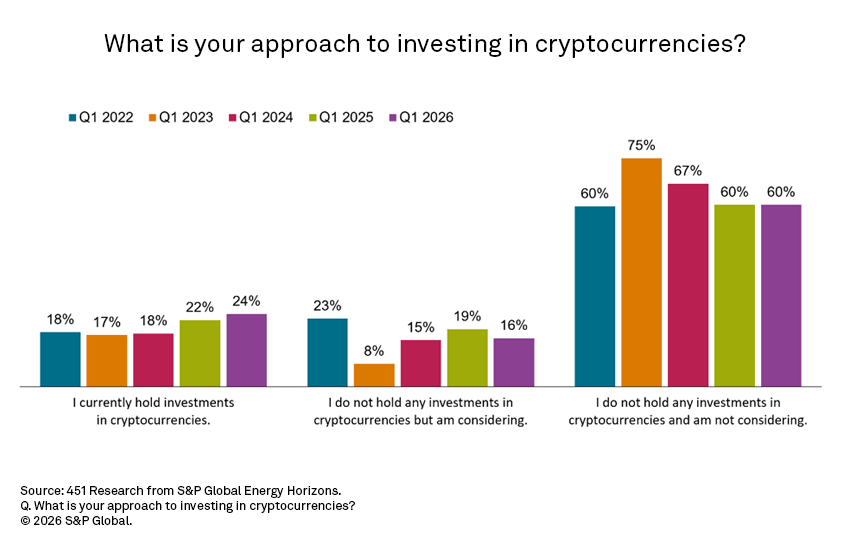
Investors remain divided on the usefulness of cryptocurrency. Among the majority of respondents (60%; unchanged) who do not own crypto, 64% say this is due to a lack of trust and 41% note that prices are too unstable. In contrast, respondents who invest in cryptocurrencies say they do so to diversify their portfolios (67%) or because they feel it’s a good general investment to grow wealth (51%).
Bitcoin and ethereum remain the most popular cryptocurrencies. Bitcoin (74%) and ethereum (55%) remain the most-owned cryptocurrencies by respondents. They are far ahead of the next-closest coins, Solana (24%) and XRP (19%), due at least in part to the much larger market caps the two leaders enjoy over the other cryptocurrencies. Cardano’s ADA (11%) is showing a sizeable seven-point drop compared with last year, which reflects the cloudy outlook surrounding the currency.
Stocks and ETFs remain the primary vehicles for self-directed investing. As in previous years, 71% of respondents say stocks and ETFs are the asset types that account for the biggest chunk of their self-directed investing portfolios. This is almost double the allocations for mutual funds (37%) and more than double investments in bonds (25%) and options/futures (25%). Cryptocurrency (17%) is the only other investment vehicle in double digits, but it remains well behind the others. It’s worth mentioning that the use of cryptocurrencies is somewhat lower among self-directed investors compared with the 24% of total respondents who include crypto in their overall investment portfolios.
Charles Schwab continues to be the most deployed investment platform. The Charles Schwab (including TD Ameritrade) brand continues to be utilized by more than half of self-directed investor respondents (51% use website; 42% use mobile app). Fidelity, used by roughly one-third of respondents across its mobile app (31%) and website (31%), comes in a strong second. Another 19% employ the combined E*TRADE and Morgan Stanley brands’ mobile apps, and 17% use their websites. These results largely correspond with previous surveys, highlighting the relatively low levels of churn among the top consumer investment firms.
Mobile app and website satisfaction show room for improvement. One unique aspect of self-directed investing is that customer satisfaction with the financial services themselves is separate from satisfaction with the technology deployed to interact with their accounts. Focusing on investment apps and websites, the survey demonstrates suboptimal satisfaction ratings across the board.
Only one brand shows more than half of their users saying they are very satisfied. That brand is Fidelity’s website (57%). Its mobile app is close behind at 49%. Every other investment brand’s online presence is below the 50% “very satisfied” threshold, including Charles Schwab (45% app; 48% web), Morgan Stanley/E*TRADE (46% app; 46% web) and Vanguard (44% web).
Mobile investing apps are underutilized. Self-directed investors with the highest discretionary income remain the most hesitant to fully embrace mobile apps, yet they are showing signs of improvement. Only 40% of respondents say they currently use mobile devices for investment-related activities, six points ahead of last year’s survey.
When asked why they don’t employ mobile apps for investing, the top reason cited is the user experience (49%), followed by security concerns (37%) and simply having no need (29%).
These findings are supported by the fact that customer satisfaction with investment websites is higher than for mobile apps.

FinOps and the future of cloud spending automation
Want insights on fintech trends delivered to your inbox? Join the 451 Alliance.
