
Source: Tero Vesalainen/iStock via Getty images.
By its nature, streaming meets consumers where they are by allowing them to engage with media in a variety of ways and across a wide variety of devices. The streaming media device ecosystem offers consumers a diverse array of options compared with most other technology spaces. Faced with options that span both dedicated and multifunction devices, the majority of consumers opt to use the latter due to a mixture of cost and convenience.
This blog post presents findings from a study conducted by 451 Research by S&P Global, which asked US consumers about their streaming services, device ownership and customer satisfaction.
Key takeaways from the survey
Uptick in streaming device buying plans. Overall, the number of respondents saying they plan to purchase a new streaming media device in the next 12 months increased by four points year over year to 19% in our current survey. But there’s a catch. Most of that increase is centered around demand for two devices: Smartphones and Apple TV, both of which show two-point increases. Demand for most of the other device types is on par with last year’s survey.
This finding is inline with the general pattern we’re noting for device upgrades, where almost half (49%) of respondents say they typically hold onto their streaming devices for five years or longer. For smartphones, only about one-third (36%) of respondents say the same, which is likely why they are showing an increase when most other streaming devices are not. Apple TV is a bit unique in that its popularity among Generation Z (40% are interested in buying) is enough to boost its overall ranking.
Multifunction devices are enough. As mentioned, one of the main reasons for the elongated streaming device replacement cycle is that most consumers use multifunctional devices to meet their streaming needs. Smartphones (44%), smart TVs (36%) and laptops/desktops (31%) have long stood out as the most deployed devices for streaming video content. Tablets (22%) are also a popular option, as are video game consoles (13%). The most successful dedicated streaming device brand has been Roku (24%), followed by Amazon Fire TV/Stick (17%). From the consumer’s perspective, there is an inescapably tangible convenience to utilizing a multifunction device over a dedicated one.
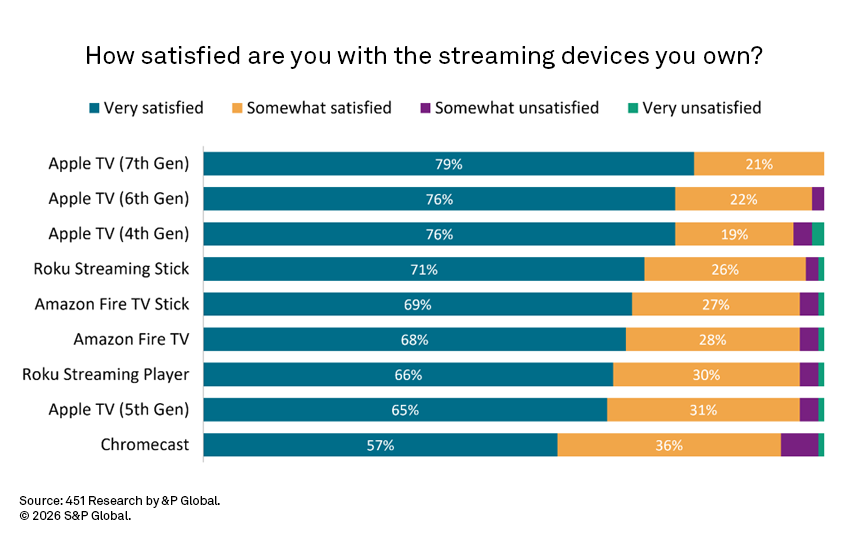
Strong customer satisfaction across streaming device brands. When it comes to dedicated streaming devices, the survey found that Apple TV’s seventh generation (79%) and Apple TV’s sixth generation (76%) have the highest percentage of users who say they are very satisfied with their devices, followed closely by Apple TV’s fourth generation (76%). Meanwhile, the Roku streaming stick (71%) and Amazon Fire TV Stick (69%) are on par with the Roku streaming player (66%) and Amazon Fire TV (68%). Chromecast again brings up the rear, with 57% of users saying they are very satisfied.
Cost remains a major factor. A big reason why smartphones are consistently one of the most used streaming devices is that they’re already in consumers’ pockets and are being employed for a variety of other tasks. As such, their utilization for streaming video is similar across income categories, with lower-income (less than $50,000 per year) at 47% and higher-income ($100,000-plus per year) at 42%. Across most of the other top device types, higher-income households deploy streaming devices at noticeably higher rates compared with lower-income ones, with key differences among smart TVs (40% versus 32%), laptops/desktops (35% versus 28%) and Apple TV (13% versus 4%).
Samsung is the most used smart TV. As noted, one-third (36%) of respondents use a smart TV to stream video content. Among this group, Samsung (36%) stands well above its closest rivals, LG (18%) and Vizio (17%). Roku (10%), TCL (10%) and Sony (10%) are the only other brands to garner double-digit deployment. In terms of satisfaction, almost three-quarters (72%) of respondents say they are very satisfied with their smart TV.

The Smart Home Era is Here
Want insights on consumer technology trends delivered to your inbox? Join the 451 Alliance.
