

Source: S&P Global Media Portal via S&P Global.
Edge computing is at a significant budgetary inflection point, driven not by gradual infrastructure upgrades, but by the urgent integration of advanced services and AI, according to a study conducted by 451 Research by S&P Global.
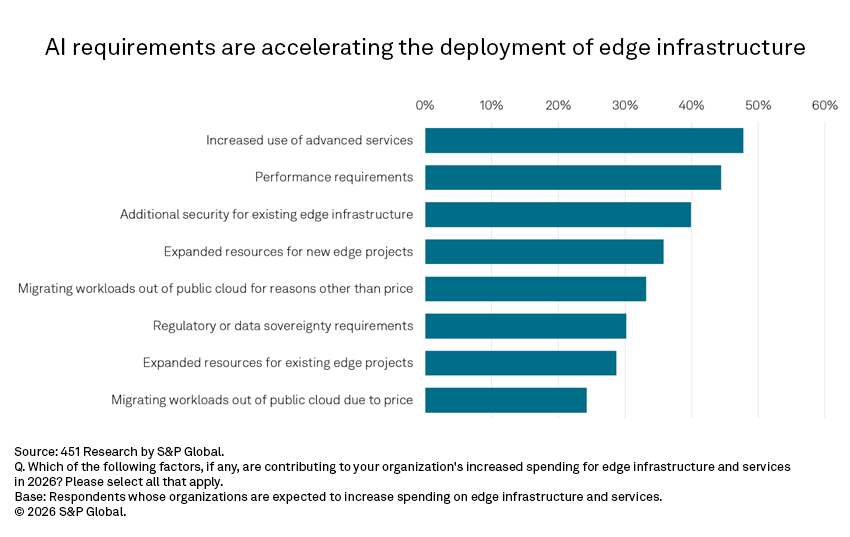
Over 95% of organizations expect to increase spending on edge infrastructure and services in 2026, with 41% planning to increase their budgets by more than 50%. Crucially, these new AI requirements are strongly additive to edge budgets rather than cannibalizing existing projects.
However, as edge portfolios mature to include advanced machine learning operations (MLOps) and complex AI pipelines, organizations are struggling with structural cost governance and the operational realities of distributed deployments.
The Take
For technology vendors and platform providers, the sheer volume of edge spending growth is less important than where it is going. Buyers have moved beyond purchasing raw hardware; the investment gravity has shifted entirely to operationalizing edge infrastructure. The new budget priorities — MLOps, security for AI workloads, and data governance — signal that the edge is becoming a critical venue for business operations rather than isolated pilot projects. Vendors must prioritize robust financial operations (FinOps) and EdgeOps capabilities because a lack of cost visibility across distributed sites is creating an operational hangover for buyers. Furthermore, the high degree of joint IT and business ownership in edge purchasing underscores that solutions must cater to both traditional central IT governance and operational technology (OT) realities. If a vendor’s offering requires a massive integration burden or obfuscates the total cost of ownership, it will fail to capture this explosive budget growth.
Summary of findings
AI is a budget multiplier, not a cannibalizer. The edge is expanding rapidly, and AI is the primary catalyst. Overall, 95% of organizations expect edge spending to increase in 2026, with 48% citing the increased use of advanced services (AI/ML, internet of things, augmented reality) as the primary driver. More importantly, 54% of respondents report that AI edge requirements will add to the budget originally planned for other edge projects, demonstrating that AI is unlocking net-new funding rather than merely redirecting it.
Investment is shifting from hardware to the operationalization of AI. When asked where they expect to spend more in 2026, respondents point squarely to the operational layers. AI model deployment and management at the edge (MLOps/large language model operations) leads at 46%, far outpacing edge hardware (31%). Furthermore, specific AI-at-the-edge spending is highly concentrated on securing the environment (43%), edge compute acceleration (41%), and data pipelines (41%). This highlights that organizations are aggressively shifting from infrastructure build-out to value extraction.
The FinOps hangover hits the edge. Despite massive spending growth, governance remains critically immature. Only 33% of organizations report having mature forecasting and ongoing optimization processes for edge costs, while 57% are merely developing these capabilities. Consequently, the top cost-related challenges are higher-than-expected cloud and connectivity costs (39%), and the cost of operating and maintaining environments at scale (37%). Vendors that offer transparent, predictable cost models will have a major competitive advantage.
IT/OT convergence requires joint purchasing models. The days of edge being purely a centralized IT science project or an isolated OT silo are over. While central IT remains the primary owner of edge spending for 38% of organizations, a substantial 28% report joint ownership between IT and business/operations. This shared accountability requires vendors to navigate complex, multi-stakeholder buying centers and prove value to both IT architects and line-of-business operators.
Strategic outcomes center on resilience, not just latency. Edge investments are being justified by foundational organizational goals. The top expected outcomes are advancing digital transformation objectives (43%), improving data locality and sovereignty (42%), and improving resilience and uptime for critical operations (42%). Reduced latency — often touted as the primary edge driver — is cited by only 28% of respondents, underscoring that edge computing is now viewed as an indispensable foundation for reliable digital business.

Smart buildings and the resilience imperative
Want insights on AI trends delivered to your inbox? Join the 451 Alliance.
The author(s) used an AI platform in the production of the report this blog post was based on. It was subsequently peer-reviewed, fact-checked and edited before publication. S&P Global uses generative AI to create content in accordance with our Terms of Use.
This content may be AI-assisted and is composed, reviewed, edited and approved by S&P Global in accordance with our Terms of Service.
