

Source: Zaptec/Photos via Unsplash.
As electric vehicle (EV) charging moves deeper into fleet, logistics and commercial operations, it is becoming more than a facilities project. Battery-backed charging combines EV supply equipment, battery energy storage and software controls to coordinate power among the grid, batteries, chargers and other on-site resources. For technology leaders, this creates a new operational technology environment in which software, cybersecurity, integration and asset data are central to performance.
Why storage is moving closer to the charger
High-power charging can exceed the capacity available from a site’s grid connection. A battery can charge within that limit, or when electricity prices are lower, and discharge during charging peaks. This allows charging output to temporarily exceed grid input. Depending on the site and jurisdiction, battery buffering may also defer transformer upgrades, larger grid connections and related utility approvals.
Two main architectures dominate this space: 1) Integrated battery-buffered charging, 2) Site-level battery energy storage system (BESS) or microgrid architecture. Integrated battery-buffered charging is designed around an individual charger or charging island and is typically modular and repeatable. BESS or microgrid can coordinate multiple chargers, buildings, distributed energy resources and facility loads. The first approach fits public charging, fuel retail and grid-constrained urban sites; the second is better aligned with fleet depots, logistics hubs and commercial or industrial locations.
Charging infrastructure becomes an IT and OT system
Fleet requirements make the technology challenge more demanding. In a recent survey conducted by 451 Research, 54% of respondents cited greater operational criticality and time sensitivity as differences between fleet and residential charging, while 47% cited higher power levels and grid upgrades. Commercial deployments may use DC fast chargers ranging from hundreds of kilowatts to more than 1 MW per vehicle.
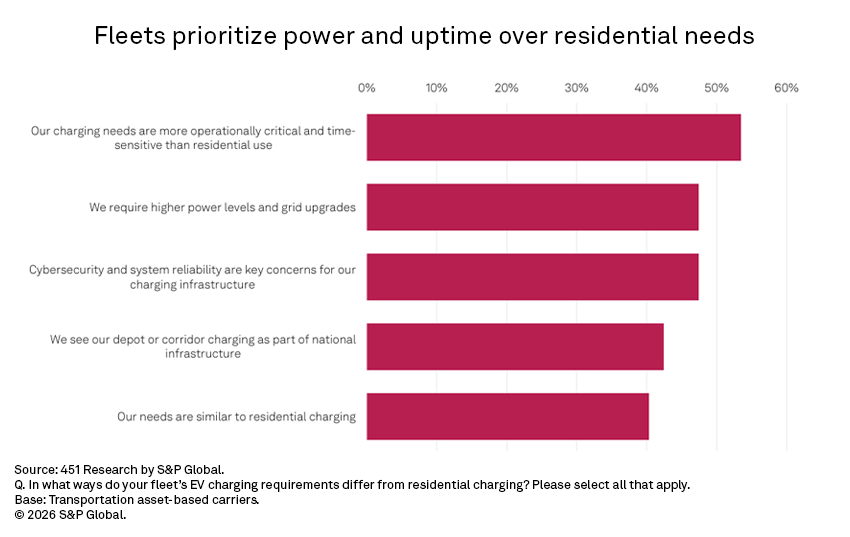
Software must therefore do more than manage charging sessions. Platforms are evolving to forecast demand, optimize battery dispatch, coordinate charging and storage, control electricity costs and monitor asset performance. Tariff structures add complexity because an energy management system may need to anticipate peak-risk windows without compromising vehicle availability.
For Chief Information Officers (CIOs), Chief Technology Officers (CTOs) and infrastructure leaders, evaluation should cover these five connected areas:
- Interoperability: Can the platform integrate with existing switchgear, building loads, energy management systems and on-site generation?
- Cybersecurity: Does the vendor apply security-by-design, software life cycle management, remote diagnostics and appropriate regulatory controls?
- Operational resilience: Can the system maintain required charging schedules within site and grid constraints?
- Battery life cycle management: How are degradation, throughput limits, thermal performance, warranties, augmentation and end-of-life planning handled?
- Multi-site intelligence: Can teams manage forecasting, optimization, analytics and orchestration consistently across locations?
Architecture decisions shape long-term flexibility
Sizing requirements vary considerably by use case. Typical deployment models range between 125-500 kW and 0.25-2 MWh for public charge point operators today to 10-30 MW and 20-120 MWh for heavy-duty truck charging. Over the next five years, the representative heavy-duty profile is expected to rise to 20-50 MW and 50-200+ MWh. These are not deployment forecasts; actual sizing depends on utilization, charger density, grid availability and regional conditions.
That scale makes charging infrastructure an organizational architectural decision. Buyers should model the trade-offs among grid upgrades, battery sizing and charging schedules rather than selecting chargers in isolation. They should also preserve physical space and electrical flexibility for future storage integration.
Building a scalable site-energy architecture
A site-level assessment that joins facilities, fleet operations, IT, security, finance and utility stakeholders is a great place to start. Next, define the primary business case. Is it to enable high-power charging, improve uptime, reduce energy costs or defer infrastructure upgrades? Possible secondary and market-dependent grid-services revenue should also be thought through.
Then, evaluate the complete charging-and-storage system, not just charging hardware. Differentiation is expected to center on software, energy orchestration, grid-capacity optimization, battery life cycle management, cybersecurity and serviceability. As charging converges with distributed energy resources, these capabilities will determine whether battery-backed infrastructure remains a collection of assets or becomes a manageable, resilient site-energy platform.

How Consumers Feel About Autonomous Vehicles
Want insights on smart car technology and automotive industry trends delivered to your inbox? Join the 451 Alliance.
The author(s) used an AI platform in the production of the report this blog post was based on. It was subsequently peer-reviewed, fact-checked and edited before publication. S&P Global uses generative AI to create content in accordance with our Terms of Use.
This content may be AI-assisted and is composed, reviewed, edited and approved by S&P Global in accordance with our Terms of Service.
