
Source: AdobeStock_480884814/S&P Global Media Portal via S&P Global.
Workforce planning is shifting away from head count alignment and toward capability orchestration. HR leaders recognize that skills intelligence is the foundation for this shift, but many organizations are not yet set up to use skills data in ways that employees trust, managers can act on and AI-driven work redesign requires.
The Take
Workforce planning is becoming a test of whether HR can turn skills data into decisions that employees and managers both trust. Our data shows demand for better visibility into skills, capability gaps and future readiness, but weaker evidence that organizations have embedded that intelligence into how work is designed, staffed and developed. Managers show stronger demand for skills intelligence, learning platforms, analytics and AI governance, while non-managers place more emphasis on work sustainability and the lived experience of change. That divergence is consequential. If skills-based planning is built mainly for managerial allocation, employees may experience it as surveillance or a new basis for exclusion. HR leaders will need to connect skills infrastructure, AI enablement and employee trust into one operating model.
Context
Workforce planning has always had to account for structural pressures: shortages in critical roles, regulatory change and the need to align talent strategy with business strategy. What is different now is the pace and volatility of episodic disruption. M&A activity, rapid market expansion, nearshoring, restructuring and AI adoption can all require organizations to reallocate skills and capability rather than simply resize head count.
That shift raises the bar for workforce intelligence. Data from a study conducted by 451 by S&P Global shows that HR leaders recognize the urgency. Employee skill development, reskilling and future skills readiness ranked as HR’s top strategic priority, selected by 45% of respondents. But the operating model required to act on that priority remains immature. Many organizations want better skills visibility; fewer have embedded skills intelligence into the decisions that shape work, development and AI adoption.
The result is a workforce planning agenda pulled between two needs: the managerial need for better capability allocation and the employee need for developmental systems that feel credible, fair and worth participating in.
Skills are the declared priority, but not yet the operating model
When HR respondents were asked what employee data or insights they would most like to gather if they could, skills and skills proficiency ranked first at 50%, ahead of “daily productivity and output” at 44% and “potential fit for internal roles” at 40%. HR leaders are identifying the missing layer that makes workforce planning, internal mobility, succession and reskilling operational.
The issue is not that organizations lack employee data. Most can see who they employ and what roles they hold. Many can infer skills from job titles, learning histories, manager assessments or self-reported profiles. Far fewer can see the moving target: how work is decomposing into tasks, which tasks are being augmented by AI and which new capabilities are emerging in real time. Without that visibility, workforce planning defaults to proxies. Succession plans rely on roles rather than verified capability. Internal mobility programs route employees by tenure or manager sponsorship. AI-augmentation assessments compare tools against static job descriptions rather than the actual task composition of work.

AI adoption, trust and changing work practices
The skills-data finding should therefore be interpreted as a capability warning rather than a feature request. Skills mapping, proficiency tracking and intelligent gap analysis are preconditions for many of the programs HR leaders are being asked to scale. Without them, organizations can invest in performance management, learning content and AI-enabled tools while still lacking a reliable answer to the most basic question: What can our workforce do now, and what will it need to do next? The gap is underscored by another finding: Only 16% of line-of-business managers say skills intelligence is central to their organization’s workforce planning or employee development. Skills may be strategically important, but they are not yet institutionally central.
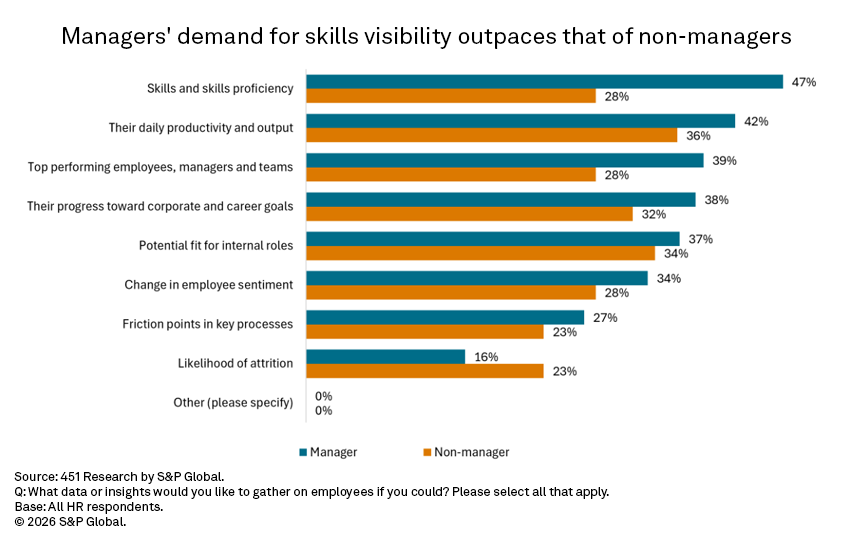
Managers’ responses show why this disconnect matters operationally. They are nearly twice as likely as non-managers to want skills proficiency data (47% versus 28%), and are also somewhat more likely to want daily productivity data (42% versus 36%) and data about changes in employee sentiment (34% versus 28%). Managers are being asked to staff work, identify successors, develop teams and make sense of AI’s effect on roles with incomplete evidence about capability. The risk is that workforce planning becomes more ambitious without becoming more empirically grounded.
Investment intentions show a sequencing problem
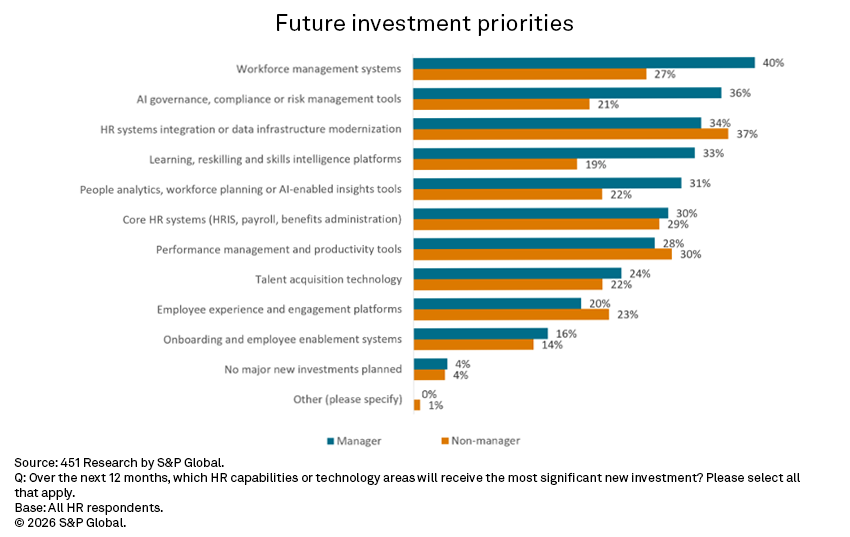
The investment data reveals an organization still building the plumbing for more sophisticated workforce planning. HR systems integration or data infrastructure modernization ranked first among areas expected to receive significant new investment over the next 12 months at 35%, followed by workforce management systems at 34%. Core HR systems and performance and productivity tools each registered at 29%. Learning, reskilling and skills-intelligence platforms ranked seventh at 26%.
This pattern suggests many are sequencing foundational systems before more advanced capability-building tools, which is understandable given the data integration required to make skills intelligence useful at scale. But it also creates a timing problem. The strategic workforce-planning agenda is moving toward dynamic capability orchestration, while investment remains concentrated in systems of record, coordination and control.
The manager/non-manager split sharpens the point. Managers are more likely than non-managers to identify workforce management systems (40% versus 27%); AI governance tools (36% versus 21%); learning, reskilling and skills intelligence platforms (33% versus 19%); and people analytics, workforce planning or AI-enabled insight tools (32% versus 22%) as top investment areas. Non-managers show slightly greater emphasis on HR systems integration or data infrastructure modernization (37% versus 34%). Managers appear to be prioritizing tools that help them allocate, govern and optimize work. Non-managers’ responses point more toward the foundational systems that shape the employee experience.
HR leaders should not treat those priorities as competing agendas. Skills intelligence depends on both the data architecture needed to connect people, roles and work, and the planning tools needed to turn that information into decisions. The adoption risk is that organizations build workforce-planning infrastructure primarily around managerial urgency. Employees are more likely to support new systems when they can see the personal exchange: less friction, clearer opportunities, better guidance and fairer decisions. If learning and skills intelligence investments are positioned mainly as management tools for planning and measurement, adoption will likely be shallow. If they are positioned as a way to make careers more navigable, they have a stronger chance of becoming trusted infrastructure.
Want insights on workforce productivity and collaboration trends delivered to your inbox? Join the 451 Alliance.
