

Source: The data center/S&P Global/S&P Global Media Portal.
Most organizations say public cloud storage use is cutting into on-premises storage budgets, making cost reduction more important than ever. Organizations expect average annual data growth of more than 30%, and data management across cloud environments has become increasingly challenging. Additionally, data sovereignty requirements are driving organizations to increase spending for both on-premises storage assets and public cloud storage services, according to a study conducted by 451 Research from S&P Global Energy Horizons.
The Take
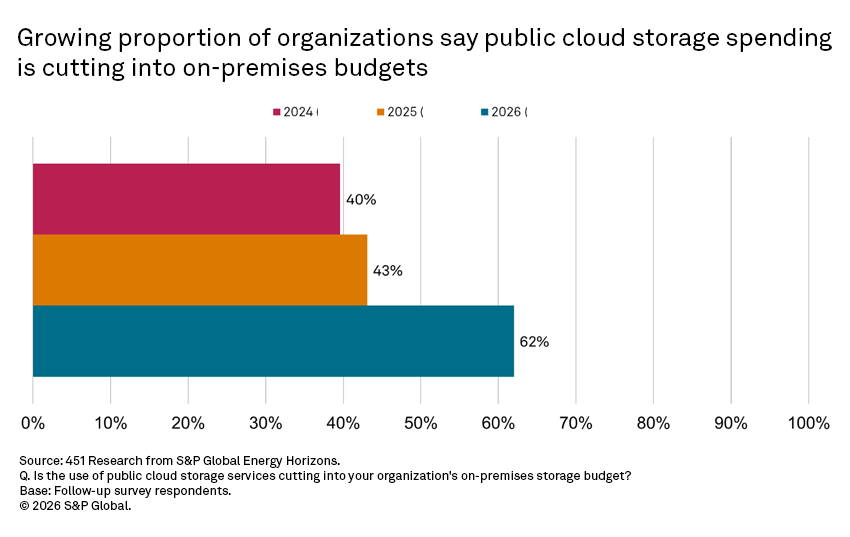
Organizations are bracing for a significant surge in data under management, with average expected growth of 31% for the next 12 months — up from 29% a year ago and markedly higher than the 23% anticipated in 2024. Rising operational costs, challenges in managing data stored with third parties, and steep capital expenditures associated with on-premises storage are compelling organizations to adopt automation and optimization strategies such as tiering to curb waste. While on-premises budgets are projected to expand by an average of 28% in 2026, increased public cloud use is beginning to cut into this spending: 62% of respondents say cloud storage service costs are encroaching on their on-premises allocations. Additionally, data sovereignty concerns are driving investment in both on-site and cloud storage, with enhanced encryption and security protocols emerging as key mechanisms.
Summary of findings
Rapid data growth remains organizations’ top storage issue, cited by 48% of respondents. In our Storage, Budgets & Optimization 2026 study, respondents on average project 31% growth in their data under management over the next 12 months. This marks a slight increase from 29% in the 2025 survey and a significant rise from 23% in 2024. High operational costs (31%), managing data stored with third parties or in cloud environments (30%) and high cost of storage on a capex basis (30%) are also top pain points.
Budgets for on-premises storage continue to increase, but optimized spending remains essential. Expected budget growth for 2026 averages 28%, in line with projections for 2025 and higher than the 24% expected in 2024. Nevertheless, organizations cannot afford waste in the current financial environment; increased use of automation and optimization, such as tiering, will be required to keep storage spending under control.
Increased public cloud usage is driving a reduction in on-premises storage spending. Nearly two-thirds (62%) of respondents say public cloud storage costs are cutting into on-premises spending, up from around 40% in previous years’ studies. Cloud-based data protection, used in hybrid or cloud-only deployments, has been favored over on-premises-only deployments for several years, driving the trend toward cloud storage spending.
Cost concerns and organizational resistance are top barriers to StaaS adoption. Though 57% of respondents say they have deployed storage as a service (StaaS), a few challenges are preventing wider adoption. Nearly two-thirds (61%) of respondents who are not planning to deploy StaaS say their internal staff can manage storage at lower costs than vendor-provided services, while an additional 44% say there is organizational resistance to change. A third of respondents who are not deploying StaaS say their organization prefers using capex to acquire storage systems, while an additional 7% say their procurement processes do not allow StaaS purchases. A further 16% of those not adopting StaaS express doubts about the speed of capacity expansion.
Data sovereignty is an important objective for most organizations, driving increased spending for both on-premises and cloud storage. Nearly all respondents say data sovereignty is either “critically important” (32%) or “very important” (60%) to their organization’s overall data management and compliance strategies. A large share of respondents say data sovereignty efforts have led to significant increases in storage spending, both on-site (29%) and in public cloud (35%). A quarter of respondents expect data sovereignty requirements to drive a substantial increase in data storage spending in the next 24 months. Two-thirds of respondents (65%) say they are using or considering enhanced data encryption and security protocols to meet data sovereignty requirements.

What is an AI Datacenter?
Want insights on datacenter trends delivered to your inbox? Join the 451 Alliance.
