
Source: Customdesigner/iStock via Getty images.
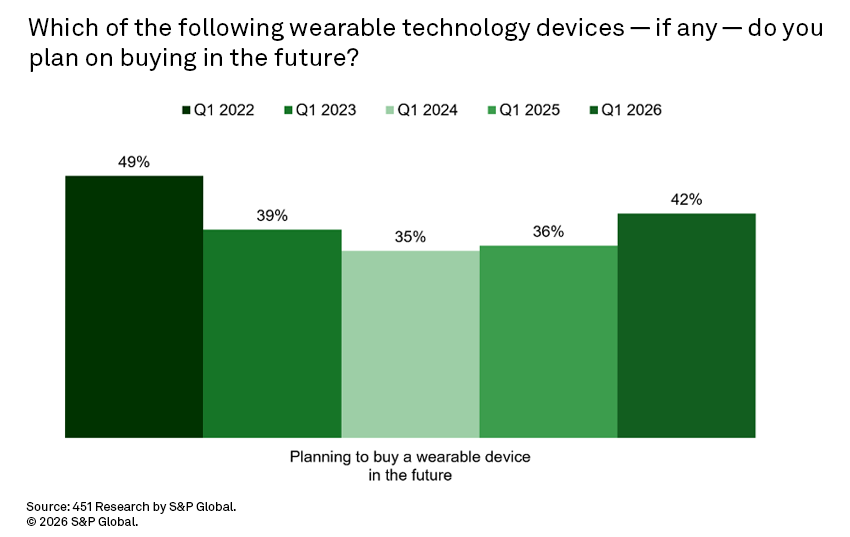
After a couple of down years, consumers have rekindled their interest in wearable technology. With the current economic environment, it’s easy to understand why consumers have been more focused on other things. But as consumers look ahead, they are showing the highest level of demand for wearables since 2022.
This blog post presents the findings of a recently conducted study by 451 Research by S&P Global, which asked US consumers about their device ownership and buying plans.
Key takeaways from the survey
Uptick in wearable interest after several-year lull. Our consumer technology surveys gauge interest in terms of consumers’ overall intent to buy. This doesn’t necessarily mean they will rush out and make a slew of new purchases, but it does provide a unique insight into consumer thinking.
Currently, 42% of respondents say they plan to buy a wearable device sometime in the future. This is a more optimistic outlook than the 36% seen in last year’s Q1 survey, and it’s the highest level of interest for wearable devices in a Q1 survey since 2022 (49%). While it is good to see consumers looking ahead with interest in this product category, the current economic environment still relegates wearable devices to the “nice to have” list for many households.
Higher interest across income groups. This renewed interest in wearable devices is not limited to higher-income households (more than $100,000 per year), as it also appears among lower-income ones (less than $50,000 per year). The main difference between these groups is in their level of interest. Higher-income households (47%) remain more interested than lower-income ones (39%) in purchasing wearable technology in the future. Part of this discrepancy is that higher-income households are more likely to buy new, innovative products in general than lower-income households. Another part is economic. Financial stressors, like inflation and energy prices, tend to have a greater impact on lower-income households compared with higher-income ones.
While Generation Z is the key wearables demographic, all age groups show interest. Gen Z consumers remain the most receptive to new technologies, with 72% saying they plan to buy a wearable device in the future. This compares with 61% for millennials, 47% for Generation X, 29% for baby boomers and 21% for the Silent/Greatest Generation. Gen Z, millennials and Gen X all show noticeable increases in interest compared with last year’s Q1 survey.
Clear generational differences in wearable device type. While smartwatches, smart earbuds and fitness trackers are the most-owned wearable device categories across all respondents, specific device preferences clearly differ with age. Millennials lead in terms of fitness tracker usage (20%), but Gen Z are the top users across the other 10 wearable device categories, including smart earbuds (40%), smartwatches (40%), smart headphones (30%) and VR/AR headsets (15%). In fact, of the 11 wearable categories listed in the survey, Gen Z or millennials are either number one or two, with the lone exception being Gen X, who are second in terms of fitness trackers, just behind millennials.
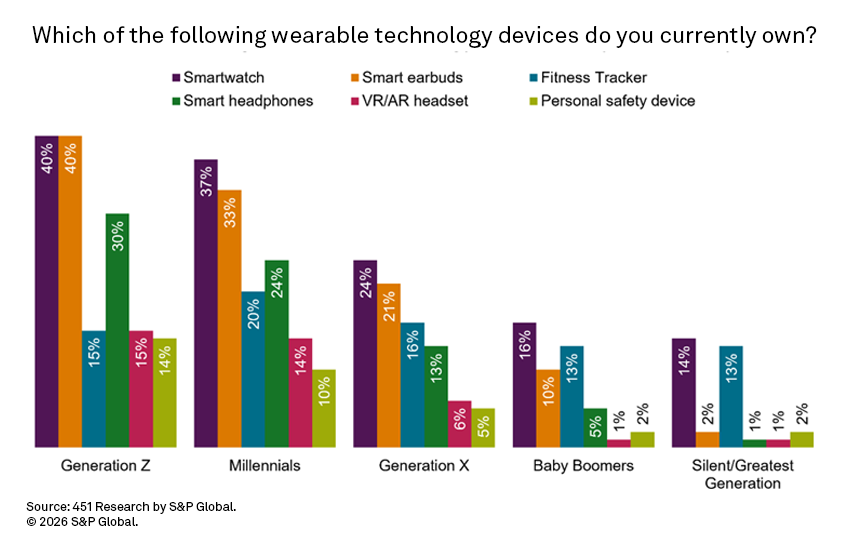
Overall, Gen X stands out as the “middle child,” trailing Gen Z and millennials, but remaining comfortably ahead of baby boomers and the Silent/Greatest Generation across practically all wearable device categories.
The Smart Home Era is Here
Want insights on consumer technology trends delivered to your inbox? Join the 451 Alliance.
