

Source: ViewApart/iStock via Getty images.
Apple and Samsung continue to dominate a mostly static US smartphone market. Based on current churn rates, this status quo doesn’t appear to be changing anytime soon. However, given that younger consumers are so highly entrenched in Apple’s ecosystem, Apples’s overall market share is well-positioned to grow as more of Generation Z reaches adulthood. Add in the fact that Generation Alpha is not far behind them and that older consumers, who tend to favor Samsung, will continue to age out of smartphone usage, and Apple’s future looks even brighter. Only time will truly tell, but here’s what a survey conducted by 451 Research by S&P Global has to say about the smartphone market.
Key takeaways from the survey
Apple and Samsung are setting the pace. Apple (46%) and Samsung (36%) continue to dominate the US smartphone market, with no other manufacturers posing a credible threat. Their only real competitors are Motorola (10%) and Google (4%). This dominance is not likely to change anytime soon, given that Apple (47%) and Samsung (34%) are also the top brands among planned smartphone buyers. Motorola (6%) and Google (4%) lag far behind. Apple and Samsung remain the most popular brands in large part because of users’ experience and familiarity with the products.
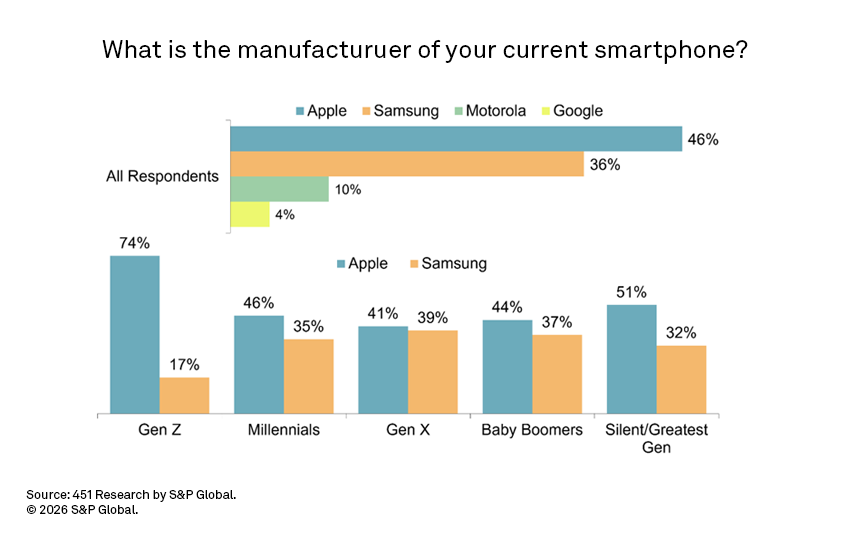
Preferences of younger consumers favor Apple. As noted in previous reports, Apple remains the most popular brand by far among Generation Z respondents (74%). Somewhat surprisingly, the Silent/Greatest Generation (51%) has the next-highest level of iPhone usage, followed by millennials (46%), baby boomers (44%) and Generation X (41%). The trend in planned buying follows the same pattern, which continues to reinforce the current status quo and is likely to push an even larger percentage of younger users toward Apple. As older users age out of smartphone usage, the higher percentage of Apple ownership among younger consumers will start to have an even greater influence on ownership rates among the population at large. There is some trendiness attached to the high usage of Apple among younger users, as Gen Z were most likely to say that they bought their current smartphone because it’s the same brand used by their friends and family (39%). In fact, Apple users overall (37%) were far and away most likely to hold this sentiment, with Samsung only at 17%.
Apple’s ecosystem is part of the allure. The data shows Apple has a higher percentage of very satisfied iPhone users (75%) compared with Samsung (70%) and Google (65%) smartphone users. While Samsung and Google do have device ecosystems of their own, Apple is perceived as having the better offering. For example, Apple owners are more likely to cite easy integration with other devices (32% versus 20% and 22%, respectively) as a factor in their brand selection.
High satisfaction rates play a big role in brand loyalty. Due in large part to its higher level of very satisfied users, 93% of Apple owners who plan to buy a new smartphone in the future say it will be another iPhone. That number is just 79% for Samsung and 58% for Google. This is another big advantage for Apple since younger consumers are already predisposed toward buying Apple iPhones. If Apple owners maintain the same very low churn rate, this would all but guarantee that the youngest generations stay entrenched within the Apple ecosystem.
Consumers have expectations of baseline functionality. Regardless of how or why smartphone users chose their devices, once in hand, owners expect them to perform at a certain baseline level, regardless of manufacturer.
When asked which smartphone features most influenced their purchasing decision, battery (61%) and camera quality (53%) were cited most, followed by display quality (46%) and large internal storage capacity (39%). Compatibility with other devices (30%) is lower in the pecking order; however, this is highest among Apple owners (37%) compared with other manufacturers.

Cloud Maturity Brings Organizational IT Change
Want insights on cloud computing trends delivered to your inbox? Join the 451 Alliance.
