

Source: SolStock/E+ via Getty images.
Employee engagement — employees’ regard for, motivation toward and commitment to their organization — has become structurally uneven yet has also become easier to measure. Post-pandemic work design has further divided the workforce into roles with different degrees of flexibility and control, undermining the assumption that engagement can be managed uniformly. Meanwhile, engagement technologies have advanced quickly. Organizations can now pinpoint where experience diverges, track sentiment more precisely and surface engagement drivers with increasing confidence. Yet the ability to act on insights has not expanded at the same pace. Work systems, especially frontline environments, remain constrained by standardized workflows, fixed schedules and limited authority to shape day-to-day experiences.
The Take
Employee engagement increasingly breaks down because insight is expanding faster than organizations’ capacity to act, and because the mechanisms that sustain engagement differ sharply across frontline and non-frontline roles. Belonging is the strongest engagement driver across both groups, but the conditions required to sustain it — timely, responsive changes to work experience — are far more achievable in non-frontline environments. Where organizations cannot reliably translate feedback into change, engagement depends on signals of trust and legitimacy. For frontline employees, this centers on credible communication of organizational intent and compensation that meets a clear threshold of fairness. For non-frontline employees, engagement is reinforced through reliable coordination and buffered by managerial care. As engagement measurement becomes more precise, organizations must align what they measure with what they can realistically change. Without that alignment, employee listening then risks becoming a symbolic exercise, raising expectations that it cannot meet and accelerating disengagement rather than preventing it.
Context
The growing gap between insight and action now defines the engagement challenge. As organizations listen more, employee expectations for change rise. Where work systems allow adjustment, engagement can be sustained; where constraints limit responsiveness, greater visibility instead highlights the gap between stated intent and reality. Improving engagement therefore requires more than knowing what matters to employees. It requires understanding where organizations can realistically respond and where they cannot. This analysis draws on a study conducted by 451 Research from S&P Global Energy Horizons, covering frontline and non-frontline employees.
Frontline and non-frontline roles differ by uneven constraints
Frontline roles deliver products or services directly, through customer interaction, manufacturing, logistics, healthcare, education and field operations. These roles typically involve standardization, fixed schedules and limited discretion over work design. Frontline roles represented in the survey include on-site construction workers, educators and instructional staff, patient-facing healthcare workers, administrative support staff, transportation and logistics workers, and food preparation and service employees, among others.
Non-frontline roles, by contrast, more often involve knowledge work, greater schedule flexibility and closer proximity to organizational decision-making. These employees generally operate within work systems that allow priorities, workflows and collaboration patterns to be adjusted in response to changing demands.
These differences are not about motivation or capability, but about uneven constraints — the degree to which employees and managers can realistically adjust workflows, schedules, priorities and processes in response to feedback. Survey data illustrates this asymmetry.
Frontline employees were less likely to feel involved in decisions affecting their work (83% versus 92%), less likely to agree that their workloads were reasonable (84% versus 92%) and more likely to work primarily on-site (56% versus 41%).
These constraints shape both employee experience and organizational action capacity, forming the structural basis for diverging engagement drivers.
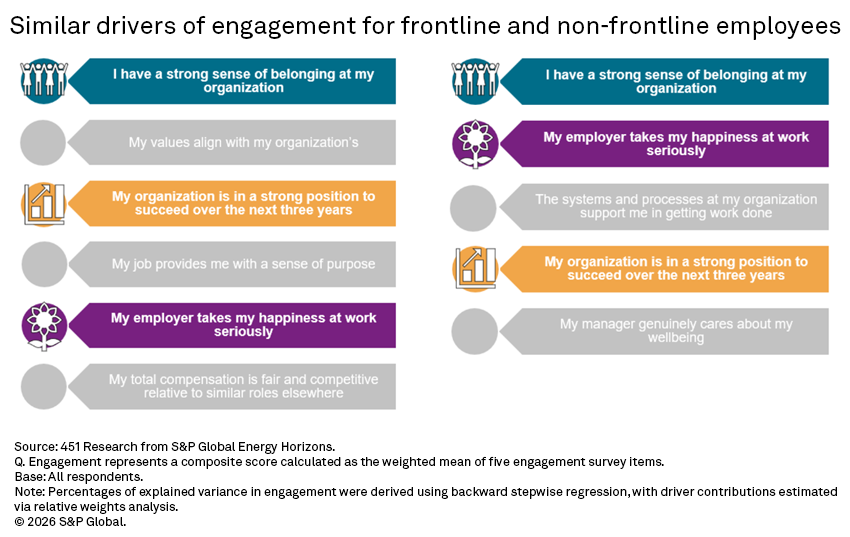
Engagement is primarily driven by belonging
Belonging — the sense of being accepted, connected and part of a shared identity — emerged as the strongest driver of employee engagement. In an environment marked by economic volatility, workforce restructuring and accelerating AI adoption, belonging functions as a stabilizing signal, helping employees interpret organizational intent and understand their place within shifting priorities.
Across the sample surveyed, uncertainty was widespread. Forty percent (40%) of employees reported concern about job displacement related to AI adoption, with similar rates among frontline and non-frontline roles. This aligns with findings from a separate survey conducted by 451 Research from S&P Global Energy Horizons, where 40% of respondents likewise expressed displacement concerns. Broader labor sentiment has also deteriorated: while 26% of organizations expected to increase full-time headcount in 2025 and only 10% anticipated reductions, that balance narrowed sharply by 2026, with 23% expecting increases and 19% expecting decreases, signaling a growing expectation of separation and restructuring.
Cost pressure and policy uncertainty reinforce this backdrop. Among organizations planning headcount reductions, 67% cited cost containment and 33% cited AI adoption, while 40% of respondents expected negative organizational impacts from US policy actions in 2026.
Together, these forces heighten employee sensitivity to cues about security, continuity and inclusion. In this context, belonging — and two closely related drivers, confidence in future organizational success and belief that the employer takes employee happiness seriously — serve as proxies for whether employees feel integrated into the organization’s future rather than exposed to its risks.
However, the ability to generate these signals is uneven. Non-frontline employees typically benefit from flexible schedules, digital collaboration and closer proximity to decision-making, creating more frequent opportunities to observe coordination, responsiveness and future-oriented planning. Frontline employees, by contrast, operate within tightly constrained systems — fixed schedules, standardized workflows and persistent time pressure — that limit these reinforcing touchpoints, even when organizational intent is positive.
Remote work modifies but does not eliminate this asymmetry. While non-frontline employees may experience fewer spontaneous interactions, they retain flexibility and multiple channels for maintaining connection and visibility into organizational direction. Frontline roles rarely afford comparable opportunities for contextual insight or asynchronous engagement. As a result, while engagement technologies can surface belonging and its adjacent signals, they cannot produce them. Belonging is created through behaviors: demonstrating care, communicating future direction and trade-offs transparently, ensuring fair scheduling and adequate staffing, enabling meaningful participation in decisions and visibly acting on feedback. Treating these drivers as universally scalable obscures the structural limits that many frontline systems face, where constraints on time, authority and flexibility make these signals harder to deliver consistently.
Compensation sets the floor for frontline engagement
In frontline roles, compensation sets the minimum condition for engagement. Pay functions less as a motivator and more as a baseline signal of fairness and respect; when that baseline is perceived as insufficient, trust erodes and higher-order engagement drivers such as belonging or purpose lose credibility. Because compensation is one of the few engagement factors frontline employees can reliably benchmark, even modest perceived inequities can trigger disengagement and turnover risk.
Patterns of turnover vulnerability illustrate this. Frontline employees are significantly more responsive to modest pay increases and exhibit substantially higher flight risk than non-frontline employees. Nearly one in four frontline workers (23%) report being very likely to leave their organization, compared with just 7% of non-frontline employees. Overall, frontline employees have nearly twice the odds of reporting intent to leave and are nearly three times as likely to express severe flight risk.
When compensation falls below a perceived threshold of fairness, engagement declines rapidly, often before signals like belonging or purpose can take hold. Organizations sometimes redirect pressure onto frontline managers or engagement programs, but these cannot compensate for perceived pay inequity. Engagement tools can surface where compensation is undermining sentiment, but they cannot redefine fairness without corresponding action.
In frontline systems, compensation is not a substitute for belonging or purpose but without meeting the legitimacy threshold, those signals struggle to remain credible.

AI moves fast, and the digital workplace struggles to keep up
Want insights on workforce productivity and collaboration trends delivered to your inbox? Join the 451 Alliance.
