

Source: i-Stockr/iStock via Getty images.
Organizational IT is maturing from utilizing fragmented, isolated monitoring tools toward building intelligent, human-guided and deeply integrated operational frameworks. According to a recent survey conducted by 451 Research by S&P Global, organizations are focusing on bridging the trust gap and addressing internal process immaturity before yielding complete autonomy to their systems, even though the technology is largely in place to automate AI-determined resolutions.
The Take
Organizations are eagerly acquiring observability and automation platforms and successfully wiring them together. Vendor messaging promises an immediate leap to hands-free, self-healing IT; however, the data provides a stark reality check. The overwhelming reliance on human-in-the-loop safeguards, coupled with the fact that the top challenges stem from undocumented workflows and a lack of staff experience, proves that you cannot automate tribal knowledge or broken processes. IT automation requires doing the unglamorous foundational work first. Use observability tools to aggressively map IT infrastructure, automate documentation and expose the gaps in IT data. The immediate ROI of AI is not in replacing human oversight, but in toil reduction — equipping IT engineers with synthesized intelligence so they fix issues correctly the first time.
Summary of findings
IT automation and observability have widespread but parallel adoption profiles. The survey data highlights a critical maturation point in IT strategy, revealing that almost half of organizational respondents are already using both IT automation and observability tools in production environments.
Specifically, 49% report active use of IT automation and orchestration capabilities, while nearly the same percentage (47%) are actively using observability platforms. Furthermore, more than a quarter of the market is in the discovery or proof-of-concept phase for these tools (24% for automation and 27% for observability).
This parallel adoption signifies that organizations no longer view observability and automation as niche operational upgrades but, rather, as foundational pillars of modern digital infrastructure. The alignment in these adoption rates indicates that organizations recognize they cannot effectively automate what they cannot accurately measure. This synchronous deployment represents the critical first step toward building intelligent IT environments, shifting the focus from keeping the lights on to establishing robust frameworks capable of supporting complex cloud-native operations.
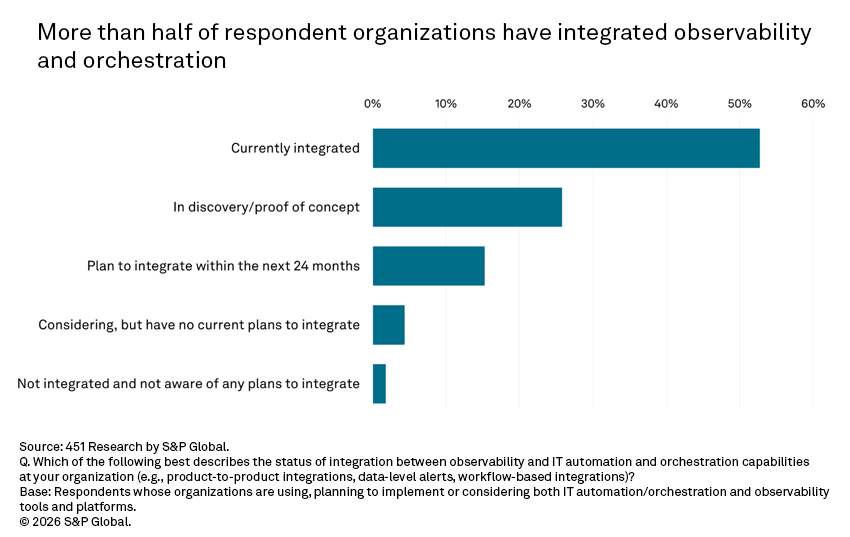
There is a push for deep systems integration. While adopting individual capabilities is the baseline, the true paradigm shift occurs when observability and orchestration are fused. The data reveals that a striking 53% of organizations have integrated these toolsets, whether via product-to-product links, data-level alerts or sophisticated workflows. An additional 26% are in the proof-of-concept phase. This high integration rate underscores a strategic departure from the historical “swivel chair” management approach, in which IT staff had to manually pivot between disparate dashboards to identify issues and execute resolutions. By tying the rich, contextual telemetry of observability directly into the execution engines of IT automation, organizations are effectively closing the operational loop. This integration acts as the central nervous system of modern IT, allowing systems to detect anomalies and immediately trigger the appropriate responses. This structural evolution signals a commitment to reducing friction in IT workflows, laying the groundwork for true automated remediation.
The human-in-the-loop approach to autonomy is dominant. Despite the rapid adoption and integration of these powerful tools, full operational autonomy remains elusive and, arguably, undesirable for most organizations at present. Only 12% of organizations have achieved a state where issue discovery, analysis and remediation are automated entirely without human intervention. Instead, the prevailing model is a human-in-the-loop approach, used by 45% of respondents. In this model, systems automatically discover and analyze issues but require human approval before executing remediation actions. An additional 22% rely on systems purely for discovery and analysis, leaving the actual remediation work directly to human engineers. This hesitation to surrender complete control highlights an ongoing trust deficit in IT automation, alongside the inherent risks associated with automated changes in mission-critical environments. Organizations prefer the safety net of human oversight to validate actions and prevent cascading failures, showing that IT leaders are consciously retaining final authority until algorithms prove infallible.
Organizations are driving ROI through toil reduction and accuracy. The integration of observability with orchestration is successfully delivering on its promise of operational efficiency, primarily by eliminating tedious manual workflows.
When citing the top IT operational benefits, respondents prioritize spending less time on data collection and formatting (33%) and a higher degree of first-time correct fixes (32%). Lowered time to resolution (31%) and better access to information for all team members (30%) closely follow.
These data points collectively indicate that the immediate ROI of integration is rooted in “toil reduction.” Instead of engineering teams burning valuable hours parsing logs and correlating data across distinct silos to pinpoint a problem, integrated platforms surface synthesized, actionable intelligence. By achieving higher first-time fix rates and accelerating resolution times, IT departments are moving from a reactive, chaotic posture to one of structured efficiency, allowing personnel to redirect their efforts toward strategic, value-driving initiatives.
Documentation and root cause analysis are top modern use cases. Organizations are thinking beyond basic automated fixes and are targeting complex, historically manual processes for their observability-initiated automation. Surprisingly, the most sought-after task for this automation is documenting IT systems and applications (35%), tied directly with performing root cause analysis (35%). Applying AI and ML to collected data (28%) rounds out the top tier. The strong desire to automate documentation speaks to a chronic pain point in enterprise IT: Infrastructure evolves faster than humans can map it. Leveraging observability data to automatically maintain accurate, real-time topology maps ensures that automation engines are acting on current architectures rather than outdated records. Similarly, using automated root cause analysis signifies a leap from simple event alerting to deep diagnostic intelligence. By focusing on these foundational diagnostic tasks, organizations ensure that when automated remediation is triggered, it is executing against a perfectly understood environment.
Organizations’ top challenges are human- and process-related. The primary obstacles organizations face when integrating observability and automation are not rooted in technological limitations but, rather, in human capital and process immaturity. The top challenge cited is a lack of experience (26%), followed closely by underestimating the level of detail required (22%), insufficient data from IT systems (22%) and undocumented workflow steps (21%). These barriers highlight a critical realization: Automation is only as effective as the processes it codifies. When IT workflows exist solely as tribal knowledge rather than documented procedures, attempting to automate them reveals glaring operational gaps. The struggle with insufficient data further indicates that legacy systems may lack the necessary telemetry to feed modern observability engines. To overcome these hurdles, organizations must upskill their workforce, clean up internal data streams and rigorously document their manual workflows before attempting to digitize them.

What is an AI Datacenter?
Want insights on data analytics trends delivered to your inbox? Join the 451 Alliance.
