

Source: Mutlu Kurtbas/E+ via Getty images.
The first quarter of the year saw some renewed interest in tablet buying. Although consumers tend to take a shopping break after the holidays, 2026 seems to be off to a better start than the previous two years. A key reason behind this somewhat more upbeat outlook is that after consecutive years of delaying new tablet purchases, it could finally be time for consumers to start a new upgrade cycle.
This report presents findings from a survey conducted by 451 Research by S&P Global, which asked US consumers about current tablet, desktop and laptop ownership, as well as customer satisfaction and purchasing plans.
Key takeaways from the survey
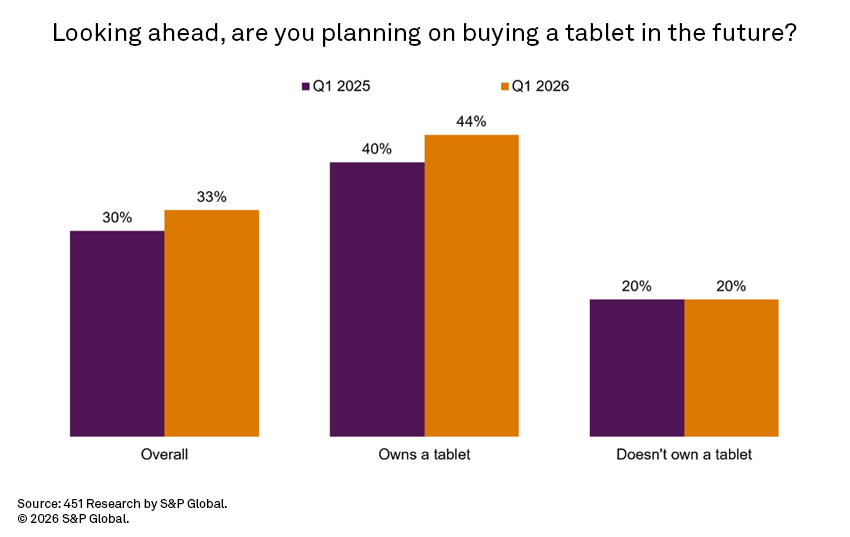
Tablet buying intent is higher than last year. For the first time in a couple of years, consumer tablet buying is demonstrating a bit more pep, with 33% of respondents to our Q1 survey saying they plan to purchase a tablet in the future This is up compared with the 30% figure seen in both Q1 2025 and Q1 2024, and the increase spans both higher-income (more than $100,000 per year; 36%) and lower-income households.
Upgrade cycles are also shortening. We asked respondents how often they replace their tablets, and just 13% said they do so within the first two years of purchase. However, this is three points higher than last year, and it corresponds with the uptick noted in buying intent.
In recent years, our surveys have shown lengthening replacement cycles. However, our latest survey also shows a rebound in the proportion of consumers who say they tend to refresh their tablet within five years of purchase (37%, up from 31% in Q1 2025). This increased buying intent might seem surprising considering the current economic environment, but after several consecutive years of consumers delaying purchases, this could be the year when they finally have to upgrade their devices.
Device refreshes are driving tablet sales. Overall, 33% of respondents say they plan to purchase a tablet. However, among those who already own a tablet, the percentage of planned buyers jumps to 44% (up four points compared with Q1 2025). Among non-owners, planned buying falls to 20% (unchanged). This illustrates that the tablet market is more dependent on current users upgrading to new devices than on increasing the total number of tablet users. This year in particular, the increase in buying intent has been completely driven by device upgrades rather than net new users.
Market leaders are unchanged and unchallenged. The tablet market remains dominated by Apple (49%), followed by Samsung (22%) and Amazon (18%), with a huge falloff before fourth-place Lenovo (2%). The inevitable churn created by device upgrades also favors these leaders. Apple (87%) has the highest proportion of current owners who say they plan to buy another iPad in the future. For Samsung, it’s 60% retention and for Amazon, it’s 46% retention. Interestingly, among those planning to change manufacturers, the majority still plan to purchase a device from one of the other leading brands, further entrenching these market leaders.
Apple stands tall in satisfaction. Apple remains the leader in tablet satisfaction, with 70% of current owners saying they are very satisfied with their iPads, followed by Samsung (63%), Microsoft (61%) and Amazon (57%). As seen in other consumer tech segments, Apple’s high satisfaction ratings are a key factor in its dominant position.
The Smart Home Era is Here
Want insights on consumer technology trends delivered to your inbox? Join the 451 Alliance.
