

Source: Group 10 0094_Large/S&P Global Media Portal via S&P Global.
Industrial organizations are entering a phase where digital ambition is colliding with the constraints of operational reality. Insights from a survey conducted by 451 Research from S&P Global Energy point to a defining theme: Progress hinges on the ability to integrate, not reinvent. A plurality of respondent organizations (31%) identify as digital infrastructure integrators, underscoring the complexity of brownfield environments and the premium placed on interoperability.
At the same time, cloud‑forward consumption models, edge‑local decision loops and accelerating AI uptake signal a shift toward architectures built for real‑time, multi‑site continuity rather than isolated pilot wins. The emerging narrative is one of disciplined modernization: Data quality, security, usability and governance will determine whether IoT, edge and AI initiatives advance from experimentation to reliable, scalable operational impact.
The Take
Vendors targeting industrial and operational technology (OT) buyers face a market that is no longer persuaded by vision alone; credibility now lies in reducing integration burdens and delivering architectures that work inside legacy‑heavy, resource‑constrained environments. The shift toward integrator‑led models signals that buyers want partners who enable assembly, not replacement. Cloud, edge and AI adoption patterns show clear demand for systems that operate reliably across distributed sites without imposing new governance overhead. The most successful vendors will focus on interoperability, clean data pipelines, operator‑ready usability and transparent life-cycle models that complement — rather than complicate — brownfield realities.
Recommendations are straightforward: design for mixed environments, prioritize API‑driven extensibility, invest in OT‑aware governance and support teams, and anchor value in measurable operational outcomes instead of feature catalogs and vision white papers. In a market defined by constrained talent, rising complexity and growing energy challenges, vendors win not by being expansive, but by being indispensable members of a partner ecosystem.
Summary of findings
Integrator mindset beats pure build-or-buy. When asked to classify their approach to digital infrastructure deployment, the largest proportion of respondents identify as integrators (31%), ahead of builders (26%), owners (21%) and consumers (19%). This points to a pragmatic center: Organizations want the benefits of cloud and edge platforms while retaining the flexibility to assemble best-fit stacks, implying demand for open interfaces, interoperable data layers, and services that accelerate assembly rather than dictate architecture.
Cloud delivery is the default for IoT apps — and rising expectations follow. Most respondents prefer to deploy IoT applications via cloud-based consumption (54%), ahead of on-premises (22%) and commercial IoT platform-delivered apps (18%). As cloud becomes the norm, buyers emphasize sovereignty and performance trade-offs, not ideology. Expect hybrid patterns where latency-sensitive functions persist at the edge while cloud hosts orchestration, analytics and multi-site governance.
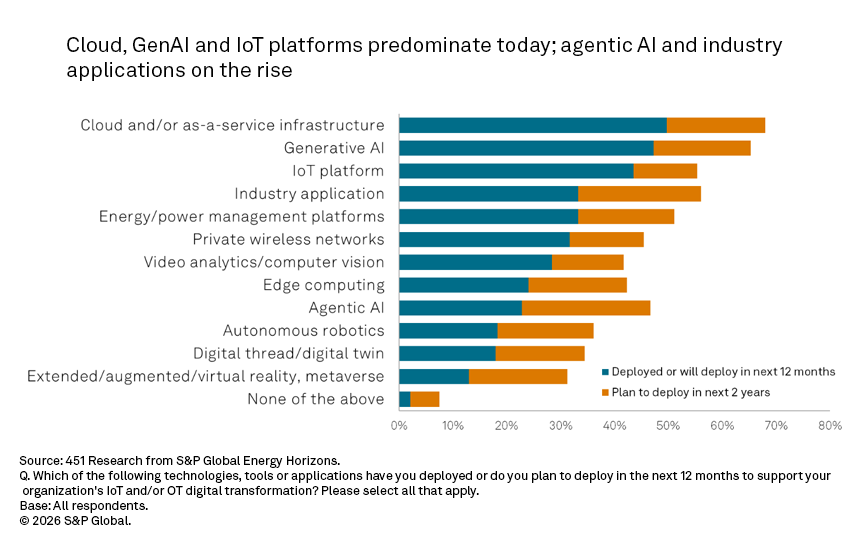
AI is already a front-line investment, not a lab project. To support their IoT and OT digital transformation, many organizations have deployed or will soon deploy cloud/as-a-service infrastructure (50%), generative AI tools (47%) and IoT platforms (44%). Looking slightly further out, over the next two years, intent is strongest for agentic AI (24%) and industry apps (23%). The pipeline skews from enabling layers to outcome-specific software, signaling a shift from generic tooling to targeted automation and decision support at the workface.
Perceived impact is highest where platforms and edge converge. Those that have adopted or plan to adopt new technologies expect the highest impact from IoT platforms (60%), cloud/as-a-service infrastructure (59%), and edge computing (57%), followed closely by agentic AI (54%) and generative AI (54%). Buyers associate impact with stack elements that unlock cross-site scale and real-time decision-making — evidence that architectural choices, not just algorithms, drive value realization.
GenAI’s OT lesson: governance first, magic later. Top-cited challenges among early deployments include a greater-than-anticipated need for oversight of GenAI responses’ accuracy and reliability (51%), limitations on data quality, access or security (48%), and issues with workforce adoption and trust (42%). The pattern indicates that productivity gains hinge on curating industrial data and clarifying accountability, not just selecting models. Governance, context and human factors remain decisive for sustainable impact.
Digital twins earn their keep in reliability and flow. Among digital twin adopters, value concentrates in predictive maintenance (59%), process optimization (56%), and safety risk analysis (55%), with energy and emissions optimization (52%) also prominent. These use cases mirror OT’s core mandate — throughput, uptime and safety — giving twins a defensible business case when tethered to maintenance KPIs, bottleneck reduction and compliance outcomes.
Edge adoption for OT is pulled by latency, cost and resilience — often together. Drivers cluster around real-time/low-latency performance requirements (54%), cost efficiency through bandwidth and storage reduction (53%), reliability based on local decision-making (52%), and support for AI inferencing near assets (49%). The common thread is deterministic performance under constrained connectivity, reinforcing designs that keep control loops and critical analytics local while synchronizing summaries and models to cloud backplanes.
Platform gaps are less about features and more about operational fit. Industrial IoT platform features deemed most in need of improvement include data quality and governance (54%); security, resilience and compliance (50%); and usability for non-technical staff (46%), followed by cost and complexity of scaling (44%). Buyers want platforms that reduce integration toil and operational friction — e.g., via cleaner data pipelines, role-based user experiences and simpler scale-out — rather than another dashboard or widget.

IoT and the Rise of Smart Spaces
Want insights on IoT trends delivered to your inbox? Join the 451 Alliance.
