

Source: S&P Global/Group 12 0086 via S&P Global Media Portal.
With increasing pressure on organizations to improve operational efficiency, safety and responsiveness, many companies are turning to frontline employee management and collaboration platforms. These digital solutions integrate task and work management tools with real-time analytics and communications to bridge the gap between traditional manual processes and the demands of an increasingly interconnected workplace. The shift away from paper-based and siloed software applications toward dynamic, integrated platforms is not just a technological upgrade — it is a strategic move designed to boost workforce coordination and efficiency.
The Take
The general value proposition for the integration of frontline employee management and collaboration technology is to foster a more connected and responsive workforce, ultimately leading to enhanced operational outcomes. The sector has evolved substantially in providing more customized, data-driven and intelligent capabilities. A wide range of industries rely on frontline employee management and collaboration tools, including retail, hospitality, healthcare, manufacturing, logistics and field services.
These tools help manage an array of use cases such as inventory, scheduling, training, customer interactions, real-time tracking, and coordination of personnel and tasks. However, the adoption of frontline employee management and collaboration tools faces several possible challenges, such as insufficient training and skill gaps — leading to inefficiency and declines in both return on investment and overall adoption rates. Additionally, a hesitance to embrace new methodologies could further impede the speed of adoption.
Frontline employee management and collaboration
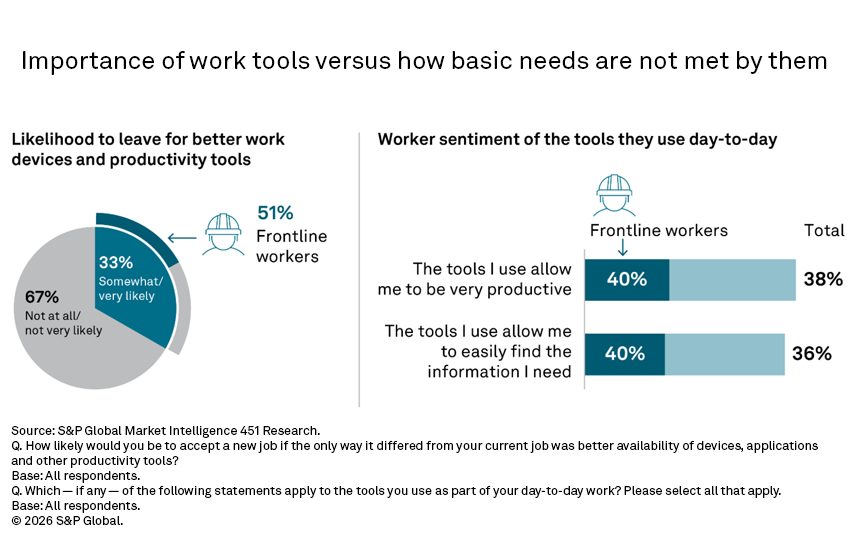
Data from a study conducted from S&P Global Market Intelligence 451 Research reveals that 33% of employees (51% of whom are frontline workers) would likely leave for better work devices and productivity tools.
Yet only 38% (40% of which are frontline workers) feel their tools help them find information easily, and 36% (again, 40% of which are frontline workers) say the tools they use allow them to be very productive.
These are some of the challenges that frontline employee management and collaboration tools hope to address by simplifying tasks through digital processes and easy-to-access tools while providing transparency and oversight to leadership.
For frontline employees, these technologies provide access to essential information and resources, enabling them to perform their tasks more effectively. Managers benefit from improved visibility into team performance and the ability to provide timely support and feedback. Additionally, organizational leaders can leverage data analytics from these tools to make informed decisions that drive business outcomes. A significant problem area that frontline employee management and collaboration technology helps address is communication breakdowns. In many organizations, frontline workers often operate in dynamic environments where traditional communication methods may fall short. By leveraging collaboration tools, employees can communicate instantly, share updates and collaborate on projects. Furthermore, these technologies help reduce inefficiencies caused by manual processes, such as scheduling and reporting, allowing employees to focus more on their core responsibilities.
Several industries utilize frontline employee management and collaboration tools, including retail, hospitality, healthcare, manufacturing, logistics and field services. In retail, for instance, these tools help manage inventory, training and customer interactions, while in healthcare, they facilitate communication among medical staff and help improve patient care. The logistics industry benefits from real-time tracking and coordination of delivery personnel, while manufacturing uses these tools to enhance production line communication and efficiency.
The sector has evolved significantly, driven by the increasing need for agile operations, as well as the rise of mobile technology that enables frontline employees to access information and communicate from anywhere. Additionally, there has been a growing emphasis on data analytics, allowing organizations to gain insight into employee performance and operational efficiencies. The COVID-19 pandemic further accelerated this evolution, as organizations halted much of their frontline operations and needed to quickly find ways to implement new safety protocols. In recent years, increasingly more vendors are expanding their capabilities to better support a wider array of industries and use cases, while smaller, more niche startups are beginning to build out robust features to better meet client needs. The future of frontline employee management and collaboration tools is likely to be characterized by even greater integration of AI, automation and enhanced personalized user experiences.
Key challenges around the adoption of frontline employee management and collaboration tools include inadequate training and skill gaps, which can lead to confusion and inefficiency, as well as drops in ROI and overall adoption. A reluctance to embrace new methodologies may also slow the pace of adoption. Addressing these challenges requires a comprehensive approach that includes training, support and thoughtful implementation strategies.

HR Transformation: from Compliance to Culture Architect
Want insights on workforce productivity and collaboration trends delivered to your inbox? Join the 451 Alliance.
