

Source: AdobeStock_2039419588/S&P Global Media Portal via S&P Global.
Decision-making in energy and utilities is shaped by a variety of factors — not just the data management and analysis tools used to enable data-driven decisions. Investment priorities and global price fluctuations, in addition to environmental regulations and geopolitical risks, play a significant role. Nonetheless, the technology involved in supporting decision-making is becoming ever more powerful and influential. Autonomous agents dominate the AI narrative. However, the reality is that AI is more constrained and far less autonomous, except for low-risk and relatively simple use cases.
The Take
In the energy and utilities sectors, many decisions are high-stakes, safety-sensitive and governed by regulations. The near-term value of AI therefore comes from improving the speed, consistency and quality of human-led decisions, owing to risks that AI-driven automation without human involvement would create. Even if a data management or analysis process used to enable a data-driven decision lends itself well to AI automation, it does not necessarily follow that it will work for full AI automation. Case in point: Synthetic data generation has a structured, model-based workflow, making it well-suited to AI automation; however, doing so carries risks, including the potential for unrealistic or misleading outputs, as well as data privacy breaches. Full AI automation of any data or decision-making approach is therefore as much about the nature and extent of the risks associated with doing so as it is about the ease with which it can be done.
Context
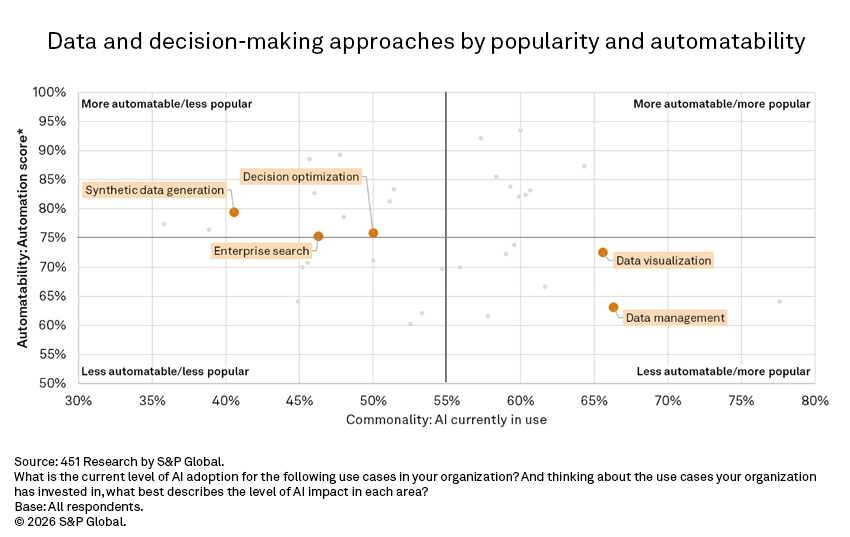
Investment in AI in energy and utilities is taking off, with over one-third of projects from 2025 now live and delivering value. AI has the potential to reframe data-driven decision-making in these industries by shifting it from a periodic, human-led activity to a more continuous and automated practice that is proactive rather than reactive. However, as the chart illustrates, AI involvement in data and decision-making functions is at relatively low levels of autonomy.
Data visualization
Data visualization is an outlier use case as it is highly automated and popular. It is a well-established practice that appeals to a broad audience and can be applied to a variety of tasks.
Control room staff, operations teams, maintenance teams, planners and engineers can all find value in using data visualization as it can be applied to many use cases, including grid and network monitoring, power outage management, customer usage analysis and field operations analytics. Data visualization is also a highly standardized process. The workflow involved in building charts, applying filters and formatting visuals is very structured, so it can be encapsulated in business rules and therefore effectively automated by AI.
Furthermore, data visualization is low risk, so it is a good fit for automation. It does not replace human judgment but assists with data interpretation, which makes organizations more comfortable automating it. Moreover, it could become more automated in the future, as operational decisions in these industries are becoming increasingly time-sensitive, making the need for immediate insights from auto-generated data visualizations more pressing. Nonetheless, human oversight might still be required because a technically valid chart may not always be the most meaningful way to present an insight.
Data management
Data management is also widely adopted, but it has not seen nearly the same level of AI automation as data visualization. Its broad adoption reflects its role as a foundation for effective analysis and data-driven decision-making. In energy and utilities, effective data management is challenging because organizations must manage large volumes of complex sensors, as well as asset, grid, market and maintenance data.

Are we the data? Data ownership and control dynamics in the GenAI age
Furthermore, full AI automation is hard because data management is context-specific and exception-heavy. Decisions about data definitions, data quality thresholds, privacy handling and governance frequently depend on business context, rather than fixed rules that can shape automation logic, so they necessitate human judgment. Full automation is risky. Errors in data cleaning, integration, classification, or governance can propagate into downstream analytics and operational systems, many of which are mission-critical in energy and utilities. This suggests that partial autonomy is likely to continue to prevail for specific, routine low-risk tasks (e.g., data quality monitoring, or metadata generation and tagging using auto-suggested datasets and descriptions).
Synthetic data integration
Synthetic data generation has so far been the least popular data and decision-making practice to be automated — even though it is well-suited to AI automation owing to the structured model-based workflow involved. However, auto-generated synthetic data often requires inspection and validation to ensure it can be successfully used, which is why organizations are reluctant to fully automate it. Privacy risks from data leakage are an issue, especially if synthetic data is generated from sensitive source data. Synthetic data can also lack statistical fidelity to real-world operating conditions, creating trust issues. Additionally, it can be prone to amplifying bias and generating unrealistic outputs, which erode confidence in using it. These risks suggest that synthetic data generation will continue to require a human in the loop.
Enterprise search
Enterprise search has been moderately well-adopted. The structured and repetitive nature of enterprise search workflows, which involve indexing, retrieval, ranking, summarization and response generation, would also suggest AI automation is pervasive. However, our survey data shows this is not necessarily so, in part because “enterprise search” is not considered an isolated category anymore. Enterprise search also continues to face credibility issues, as it has historically promised more than it can deliver, leaving many organizations skeptical of its value.
Furthermore, its effectiveness does not merely rely on a good enterprise search platform; it typically also requires organizations to make improvements to underlying content as well as related software such as document repositories, which can be challenging and expensive. Employees have a range of other ways to find information, such as asking a colleague who is a domain expert or using a search function in a specific application. This makes the business value of a unified enterprise search layer lower than in other areas. All these factors also seem to suggest that enterprise search won’t become more AI-automated and that its adoption will not dramatically increase in the future.
Decision optimization (prescriptive analytics)
Decision optimization is fairly popular and fairly well automated. The degree to which it is AI-automated might seem surprising. Decision optimization, after all, is sophisticated, mission-critical and complex — not a simple task with few risks involved in automating it. However, it can be effectively automated since data inputs, objectives and constraints are machine-executable, provided the use case has already been clearly defined and the associated business logic is sound. Nonetheless, fully AI-automated decision optimization can be problematic, suggesting it will not become significantly more commonplace.
The main risk is that decision optimization moves AI closer to recommending and therefore shaping operational decisions. Individuals need to be able to trust these recommendations, which may be based on flawed assumptions, constraints or input data that an individual may not spot if the model does not clearly explain why it recommended a course of action. Energy and utilities companies also face events such as power outages, asset failures and demand spikes, which necessitate rapid responses to changing operating conditions, and exception handling can be poor in decision-optimization systems.
Want insights on AI trends delivered to your inbox? Join the 451 Alliance.
The author(s) used an AI platform in the production of the report this blog post was based on. It was subsequently peer-reviewed, fact-checked and edited before publication. S&P Global uses generative AI to create content in accordance with our Terms of Use.
