

Source: Fernando Narvaez via Pexels.
Organizational IoT has reached a maturity milestone, shifting from isolated pilot projects toward infrastructure integrated into core operations, according to a survey conducted by 451 Research by S&P Global. The market has not moved as one, however. Among organizations already using IoT, a majority run it inside core operational or business systems, but roughly a fifth report production deployments that remain siloed. In addition, just over a quarter say their IoT initiatives are still mainly pilot- or project-based. Success rates among those who have scaled are high, and respondents credit organizational alignment and technical readiness in roughly equal measure. The top challenges holding projects back are mostly Day 2 tasks: securing IoT over time, integrating it with organizations’ applications, and managing the solution life cycle.
The Take
The organizational IoT market has transitioned from the build phase into the operational phase, but progress is uneven. For vendors, the mandate is clear: They must shift from proving IoT’s potential to demonstrating how to operate, secure and govern it reliably at scale. Organizations with successful projects credit IT/OT collaboration (53%) and a good technical starting point (49%) in statistically equal measure. This indicates that neither organizational alignment nor technical readiness is sufficient on its own, so vendor sales strategies must address both. Vendors that simplify Day 2 operations, bridge the IT/OT divide and clearly demonstrate ROI will capture the lion’s share of IoT budgets, while those focused purely on hardware or isolated pilots will see diminishing returns.
Summary of findings
Organizations’ sentiment points to a maturing but two-speed IoT landscape: Infrastructure is deeply embedded in operations for the organizations that have scaled; a persistent minority remain in pilots or silos. Future investment is pivoting toward reliability, security and governance.
IoT transitions to core operational infrastructure. Among organizations already using IoT, 53% report that it is integrated directly into core operational or business systems, and another 27% use standardized IoT platforms across multiple functions or sites. Only 2% describe their current state as small pilot deployments only. That last figure understates how much pilot-stage activity remains: 19% of the same group report multiple production deployments that are still siloed, and in a separate question covering all organizations using or considering IoT, 24% say IoT is still mainly pilot- or project-based. Together, these data points suggest that the market has an operating majority as well as a persistent minority that has not crossed over; the gap between them is where the vendor opportunity lies.
Efficiency and transformation lead the value narrative. Among organizations that use or are considering IoT, 49% view it as valuable for improving efficiency and operations, and 27% go further, deeming it essential for digital transformation. Those who view organizational IT with skepticism comprise a smaller but not trivial group: 15% say deployment challenges and risks outweigh the potential benefits, and a further 8% consider the technology overhyped and unproven. Taken together, roughly a fifth of the market still needs to be won over. The center of gravity has settled on tangible operational improvement rather than transformation for its own sake; that is the argument vendors need to make to the remaining skeptics.
Programs are stalling more often than they are shrinking. Some 31% of organizations report IoT initiatives are expanding through scaling deployments or new use cases; 44% are holding steady at current levels, while only 8% are reducing or discontinuing. The more telling number is that 17% say their initiatives have stalled or plateaued, with little to no progress beyond existing deployments. Combining the percentage with stalled initiatives and those holding steady means that roughly 6 in 10 programs are not advancing. The near-term risk to this market is not retreat but inertia, and inertia is a Day 2 problem rather than a procurement one.
Internal stakeholders are overwhelmingly supportive. Organizational buy-in is strong: 77% of respondents report that internal stakeholders are very or somewhat positive about their organization’s use of IoT, and only 4% report any degree of negative sentiment. The trajectory is also improving. Some 45% say perceptions of the teams deploying IoT are significantly more positive than they were two years ago, and 37% say somewhat more positive, compared to 5% who believe the organization’s IoT initiatives are moving in a negative direction.
Resilience and innovation drive positive sentiment. The specific drivers of positive stakeholder sentiment reveal a dual mandate for IoT: keep operations running while pushing boundaries. Half of organizations (50%) say stakeholders are positive about the company’s IoT use due to improved operational resilience and uptime, the clear leader among the options offered in the survey. Impact on digital transformation and the ability to innovate (41%) as well as enabling AI and advanced analytics initiatives (40%) follow in a statistical tie. The value of IoT is increasingly tied to both core business continuity and the ability to support advanced workloads.
ROI uncertainty remains the primary implementation barrier. Among the minority whose stakeholders hold neutral or negative views of their organization’s IoT efforts (n=79), the primary culprits are unclear value and friction in deployment: 43% cite unclear benefits or return on investment and 37% point to implementation challenges. Cost is a secondary concern, only cited by 25%, as are security or privacy worries at 19%. Value realization and integration difficulty, rather than price, are the hurdles vendors must clear, which argues for transparent business cases and simplified deployment models.
High project success rates underscore market maturity. Organizations that have deployed IoT report strong returns: 40% rate their projects to date as very successful, achieving significant ROI, and a further 45% rate them moderately successful. Fewer than 2% call their projects unsuccessful, though 14% report neutral outcomes with no significant impact. Executed under the right organizational conditions, IoT is a reliable driver of business value.
Alignment and technical readiness matter in equal measure. Technology alone does not guarantee success, but neither does organizational alignment. Among organizations with successful IoT projects, 53% attribute that success to good collaboration between IT, OT and other teams and 49% to a good technical starting point with skilled staff and capable infrastructure. A clear strategic vision and business case follows at 38%. The practical implication is that neither condition substitutes for the other: Organizational alignment without technical readiness stalls, and capable infrastructure without cross-functional ownership produces exactly the siloed deployments that a fifth of the survey respondents report.
Shortfalls are strategic and organizational, not technical. Among organizations whose IoT projects delivered minimal impact or fell short of expectations, the most-cited explanations are a lack of strategic vision or business case, efforts that did not enhance the organization’s broader strategy or plans, and a lack of collaboration among IT, OT and other teams, each cited by roughly a third of respondents. The base here is small (n=52) and weighted toward neutral rather than failed outcomes, so these results should be read as directional rather than as a ranking. One result is clear enough to survive the small base: Only 6% blame picking the wrong technology, systems or vendor partners. Buyers are not saying the tools failed them; they are indicating that the mandate and the org chart did.
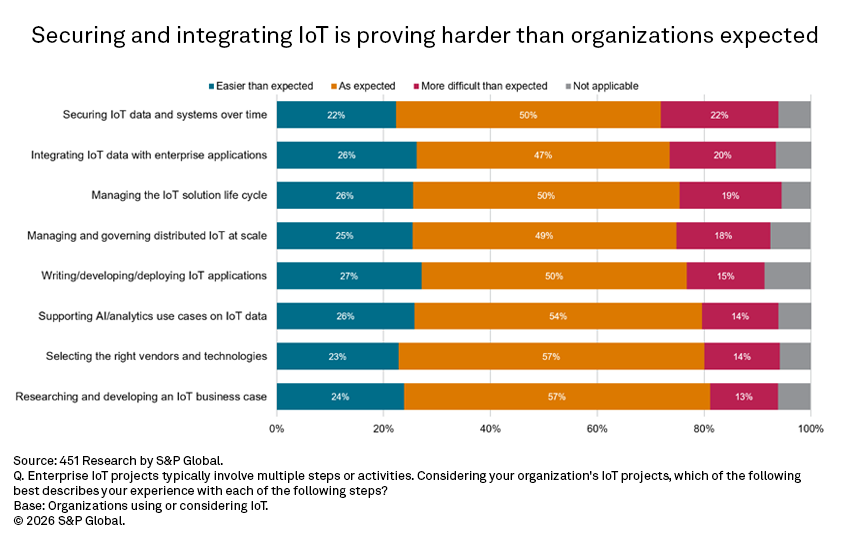
Buyers underestimated Day 2, not Day 0. The clearest evidence that the market’s center of gravity has moved is in what organizations found more difficult than they expected. Securing IoT data and systems over time tops the list with 22% of respondents citing it, followed by integrating IoT data with an organizations’ applications such as ERP, EAM and MES (20%), managing IoT solution life cycle including upgrades, tech debt and obsolescence (19%), and managing and governing distributed endpoints, infrastructure and applications at scale (18%). The activities that went most to plan are the front-end tasks: Only 13% found researching and developing the business case harder than expected, and 14% said the same of selecting the right vendors and technologies. Organizations have learned how to start IoT projects, but they are still learning how to run them.

Smart buildings and the resilience imperative
Want insights on AI trends delivered to your inbox? Join the 451 Alliance.
This content may be AI-assisted and is composed, reviewed, edited and approved by S&P Global in accordance with our Terms of Service.
The author(s) used an AI platform in the production of the report this blog post was based on. It was subsequently peer-reviewed, fact-checked and edited before publication. S&P Global uses generative AI to create content in accordance with our Terms of Use.
