
Source: Morsa Images/DigitalVision via Getty images.
The modern PC market keeps chugging along. The main players in the space, including Dell, HP and Apple, are well entrenched with virtually no major changes to their relative positioning. Consumers continue to look for devices that will perform up to their expectations and last for as long as they need, while generally leaning toward brands they already know. This creates a stagnant yet stable market that ultimately maintains the long-term status quo.
This blog post presents the findings of a study conducted by 451 Research from S&P Global Energy Horizons, which asked US consumers about current desktop and laptop ownership, customer satisfaction, and purchasing plans.
Key takeaways from the survey
Older households are the primary users of personal computers. Looking at the overall PC market, 83% of households say they own a desktop or laptop computer, yet there are noticeable differences across age and income groups. Looking at desktops, the gap across generations has a clear delineating point at baby boomers (41% ownership), which is surpassed only by the Silent Generation (57%). In comparison, only about one-third of Generation Z (31%), millennials (32%) and Generation X (36%) still live in a household that owns a desktop. Laptop usage is much more consistent, with Gen Z (58%) at the low end of ownership, along with the Silent Generation (58%). Baby boomers (64%), millennials (63%), and Gen X (63%) are all nestled closer together.
HP and Dell continue to rule over the desktop market. HP (31%) and Dell (30%) are the longtime leaders in the desktop market, with Apple (14%) holding steady in third place. These three remain the only manufacturers with double-digit ownership. In terms of planned buying over the next 12 months, Apple (31%) jumps to the top, followed by Dell (27%) and HP (26%). Apple’s leading position in planned buying is being influenced mainly by Gen Z and, to a lesser degree, millennials. Despite Apple’s perennial lead in planned buying, its overreliance on younger consumers has limited its ability to overtake more broadly used brands like Dell and HP.
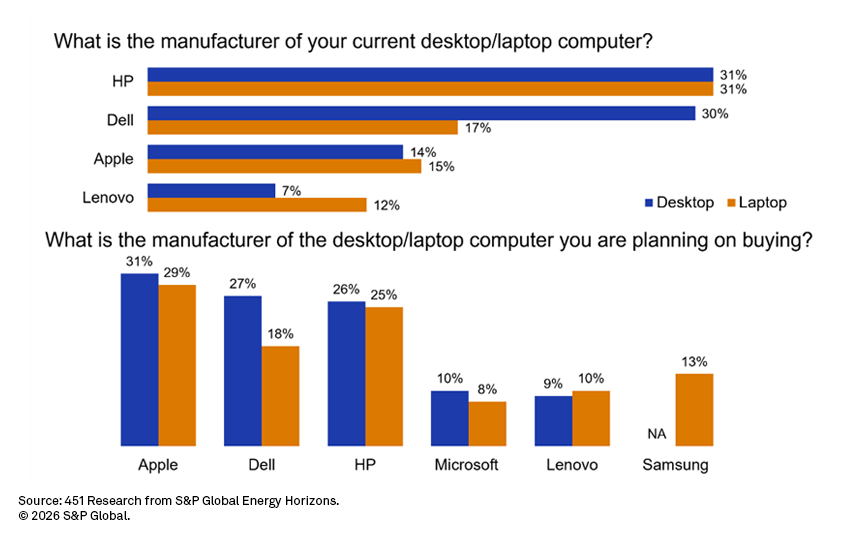
HP holds a clear lead in the laptop market. HP (31%) enjoys a comfortable lead over Dell (17%), Apple (15%) and Lenovo (12%) in the current laptop market. Apple (29%) is also the top choice among respondents planning to buy a laptop in the next 12 months, followed by HP (25%), Dell (18%), Samsung (13%) and Lenovo (10%). Again, Apple’s popularity is driven largely by Gen Z and millennials to much the same results as in the desktop market. The tightness of this market will likely also continue to reinforce the current status quo.
Apple still stands tall in customer satisfaction. Apple (74% and 73%, respectively) routinely has the most owners who say they are “very satisfied” with their desktops and laptops compared with Dell (66% and 62%, respectively) and HP (68% and 63%). This is one of the key reasons why it remains the leader in planned purchases, especially among younger consumers. But market share gains continue to come slowly for Apple because it is hard to overcome the large user bases of Dell and HP, as well as ever-evolving computing preferences and slowing refresh rates.
Consumers want devices that last. We asked respondents what aspects are most important in their purchasing decisions and found that reliability (57%), operating system (55%), ease of use (54%), durability (48%) and long battery life (48%) stand out the most. This is similar to our consumer tablets report, in the sense that consumers are most interested in desktops and laptops with good lifespans, that work properly, are easy to use, and offer a sense of familiarity.
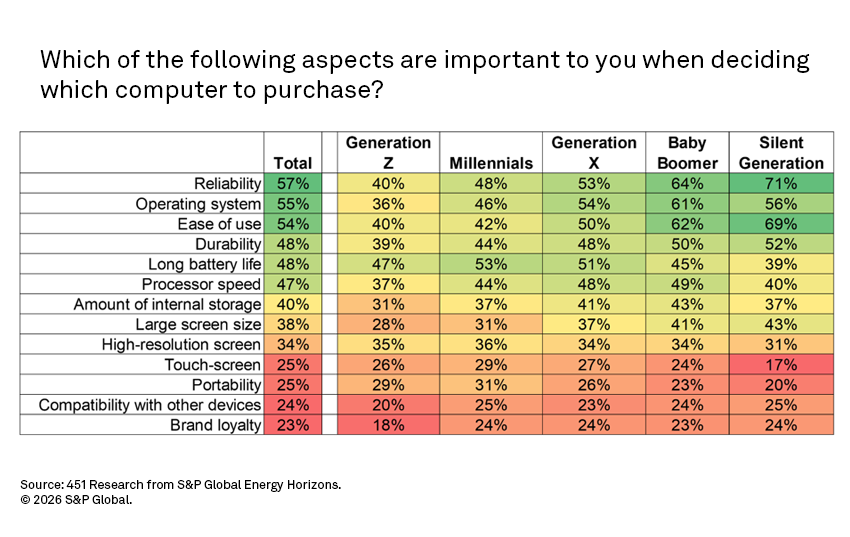
Preferences vary across generations. Gen Z (47%) and millennials (53%) view long battery life as the most important feature, while baby boomers (64%) and the Silent Generation (71%) focus most on reliability. Gen X differs a little in that they place almost equal importance on operating system (54%) and reliability (53%).
The Smart Home Era is Here
Want insights on consumer technology trends delivered to your inbox? Join the 451 Alliance.
