

Source: shaunl/E+ via Getty images.
Transportation carriers are moving into a more mature phase of digital transformation — but not in a uniform way. Truckload and less-than-truckload fleets, ocean vessels, and rail networks are modernizing under real operational pressure, and the playbook differs by region. Asia is moving fastest toward next-generation capabilities, North America is prioritizing incremental optimization and Europe is advancing within a regulation-led framework.
This blog post highlights where carriers are investing, why safety is becoming a commercial requirement, and how AI and electrification are converging into a single operational strategy.
Digital transformation is “working,” but integration and culture hold it back
Asset-based carriers report strong momentum. 86% of respondents to a recent survey conducted by 451 Research from S&P Global Energy Horizons indicate successful digital transformation implementations. Their motivations are clear: automating business processes (19%), enhancing service quality (20%) and improving system integration (12%).
Yet modernization friction is real, and it’s not just about tools. The “Legacy Anchor” effect: whereby carriers are burdened by the need to retrofit a diverse and aging fleet with modern technology, makes system integration complexity (24%) a primary barrier.
Equally important is the workforce dimension. While 67% of carriers report a growing digital skill base, there’s a meaningful difference between digital skills (using tools) and digital acumen (trusting and acting on data-driven insights). Cultural resistance remains visible (9%), reinforcing that transformation is as socio-technical as it is technological.
Regional ROI expectations signal three different transformation strategies
Carriers are pursuing digital transformation as a portfolio strategy, calibrated to local market realities:
- North America expects the highest ROI (36%), focusing on incremental efficiency gains and margin protection — an optimization-led approach.
- Asia follows (29%), supporting leapfrog investments in next-generation technology for long-term competitive advantage, even with higher execution risk.
- Europe is most cautious (27%), evaluating investments through compliance, interoperability, and long-term resilience rather than near-term returns.
What’s deployed now vs. what’s coming next
Globally, three capabilities are already widely established: standard fleet management (74%), operator/driver monitoring (74%), and container location/condition monitoring (68%). Adoption differs by region.
Over the next year, the top planned implementations include partially/fully autonomous vehicles (36%), advanced fleet management (35%), electrification (34%), remote connectivity (33%), and chassis/railcar tracking (33%).
AI is shifting from point solutions to operational gravity
AI is becoming the driver of the next phase of operational performance. Adoption is concentrated around generative AI (56%), predictive analytics (42%), and machine learning (40%).
Where is AI applied? Heaviest use is in core workflows such as logistics operations (49%) and freight visibility (44%) for load planning, dispatch, and real-time tracking. A second cluster targets order processing (46%) and customer experience automation (45%), while other use cases include financial planning/sales forecasting (40%), fraud detection (40%), workforce safety (39%), and vehicle automation/predictive maintenance (32%).
Drivers are led by operational efficiency (46%), followed by forecasting accuracy (20%) and customer experience improvement (16%). The barriers are notably data-centric: privacy and compliance (50%), data quality (40%), scalability (36%), and system integration (33%), with unstructured video data adding complexity (25%).
AI-powered safety is becoming table stakes
Carriers are ahead of the broader industry with 76% having alreadydeployed AI safety tools across at least a quarter of operations, and 22% plan near-universal deployment within two years.
Market expectations are now moving faster than regulation. Almost 80% of carriers view a partner’s AI safety capabilities as critically important, and a stronger safety posture. This is reinforced by data from advanced driver assistance systems (ADAS) (68%), camera systems (64%) and is linked to lower insurance costs, access to premium contracts, and improved driver retention.
Electrification is strategic, but charging readiness is the constraint
Electrification remains a strategic priority tied to sustainability and long-term resilience. Most carriers are still early-to-mid transition. 67% of carriers reported 25%–50% or less of fleets electrified, and only 20% exceed 50% today.
The bottleneck is readiness. Key challenges include long wait times at charging stations (46%), high up-front vehicle costs (45%), limited infrastructure access (42%), and battery range limitations (40%).
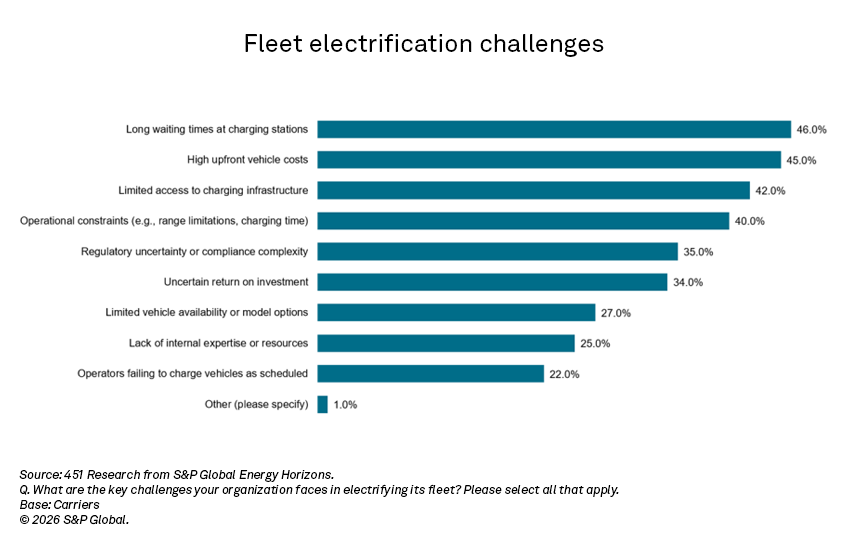
Regional dynamics matter: Asia shows strongest forward momentum and partnership engagement; Europe emphasizes analytics-driven charging performance monitoring under regulatory density; and North America faces the most acute economic barriers under margin discipline.
What are the next steps?
To turn this maturity phase into durable advantage, it’s recommended to focus on three execution moves:
- Build an integration-first foundation to overcome the “Legacy Anchor” effect: APIs, event streaming, device lifecycle management, and clean master data.
- Operationalize AI with governance: privacy/compliance, data quality, model monitoring, and clear human-in-the-loop decision rights.
- Unify safety and electrification into the operating model: safety telemetry, EV analytics, and workforce enablement should be treated as a cohesive socio-technical system.
In the end, long-term success will depend less on any single technology and more on an organization’s ability to integrate analytics, automation, AI-driven safety, and electrification across maturity stages while supporting the workforce through the change.

How Consumers Feel About Autonomous Vehicles
Want insights on smart car technology and automotive industry trends delivered to your inbox? Join the 451 Alliance.
