

Source: InstaWalli/Photos via E+Pixabay.
As advanced driver-assistance systems become standard features and autonomous vehicle development shifts from experimentation toward selective real-world deployment, consumer perception is increasingly shaping the pace and direction of automotive innovation.
Turning automotive feature technology into real customer adoption will depend on how convincingly it delivers everyday value. Trust, ease of use and clearly articulated benefits will determine whether advanced vehicle technologies can scale beyond early adopters. Automation must reduce complexity rather than introduce new sources of uncertainty, while safety, cybersecurity and system reliability need to be demonstrated, not assumed. Pricing and value delivery will also shape adoption trajectories, as consumers remain selective about what they are willing to pay for. As software and connectivity increasingly define vehicle differentiation, aligning product strategy with consumer expectations will be essential to sustaining momentum and converting innovation into durable demand.
Advanced driver-assistance systems are moving from adoption to expectation
Consumers increasingly see advanced driver-assistance systems (ADAS) as a bridge to full vehicle automation. Nearly two-thirds (62%) of respondents to a 451 Research survey from S&P Global Energy own or lease vehicles with driver assist features, and more than half expect ADAS in their next vehicle. Core capabilities such as lane assistance (64%), blind spot monitoring (61%), adaptive cruise control (61%) and collision avoidance (61%) are now widely adopted, while features like automatic high beams (49%), digital mirrors (38%) and rear automatic braking (33%) continue to gain traction. Many consumers are willing to pay a 5%-10% premium for these technologies, citing reduced driving stress. However, ease of use remains critical, with users calling for clearer instructions, more intuitive interfaces and better alerts, as complexity and overreliance continue to cause stress for some drivers.
Concerns about trust and control temper growing interest in autonomy
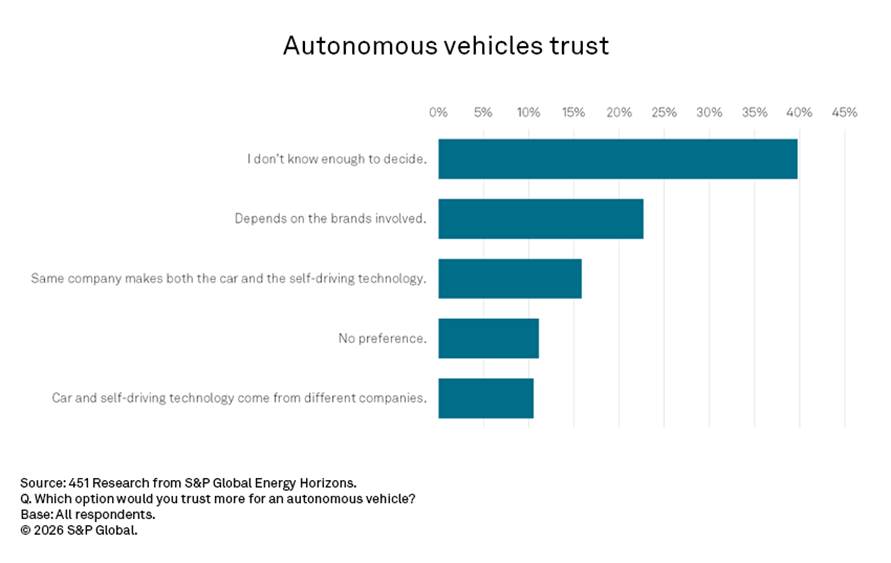
While full autonomy remains aspirational, consumer openness is growing but cautious. Awareness is still limited: 40% of consumers feel insufficiently informed, 23% say trust depends on the brand, and 16% favor companies that build both the vehicle and the autonomy stack. Acceptance is highest for Level 1 ADAS (23%) and Level 2 automation (22%), with Level 3 trailing at 15%. Interest centers on highway automation (33%), city driving (24%) and automated parking (23%), yet 38% want none of these features. Safety, liability, cybersecurity and regulation remain major concerns, and nearly 40% would pay no premium for full autonomy — highlighting stronger acceptance of AVs in controlled, commercial use cases than in private vehicles.
Robo-taxis face a trust and safety gap
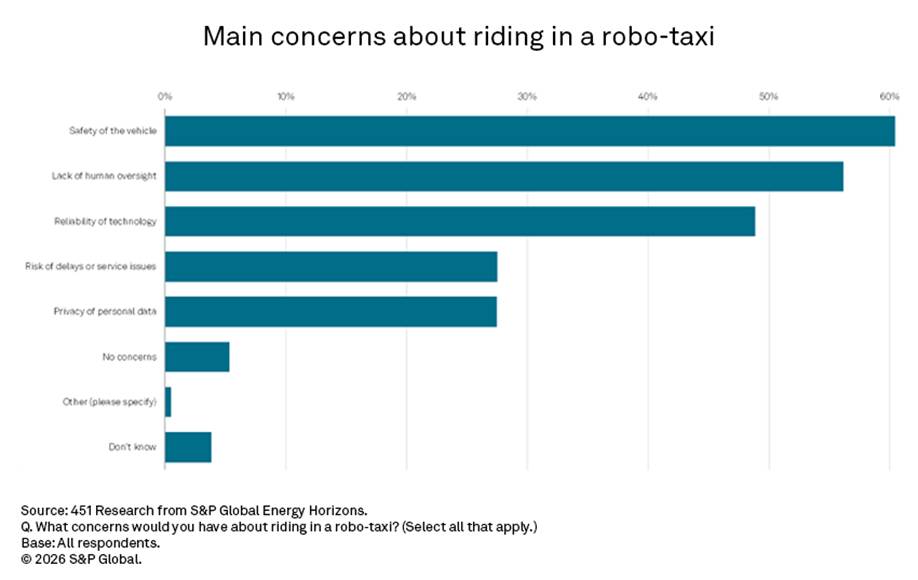
Despite significant industry investment, consumer enthusiasm for autonomous vehicles is still limited. A combined 32% of survey respondents express interest in robo-taxi services (very or somewhat interested), but 53% say they are not interested; 15% are neutral. Among those open to using robo-taxis, motivations center on lower costs, greater availability, consistent service quality and environmental benefits. Conversely, concerns are substantial, including safety (60%), lack of human oversight (56%), reliability of technology (49%), data privacy (27%), and risks of delays or service issues (28%). Preferences for in-ride activities illustrate the appeal of freeing up time that would otherwise be spent driving. In a partially automated (Level 3) vehicle, consumers would most likely monitor navigation, relax or watch media. In a fully autonomous robo-taxi, preferences broaden to enjoying scenery, resting, socializing, eating or digital entertainment.
V2X capabilities are emerging as critical enablers of safety and traffic efficiency
Survey respondents show clear interest in collision avoidance (35%), hazardous-location alerts (32%) and pedestrian detection (32%), which were the top three ranked capabilities. When asked to choose the most important feature, vehicle collision avoidance leads by a wide margin (35%). Notably, nearly 30% of survey respondents do not want any vehicle-to-everything (V2X) features in their next vehicle, highlighting persistent concerns around data sharing and technology dependency. Still, among those receptive to V2X, a majority agree that their vehicle’s data should be used to enhance the ecosystem. Willingness to pay remains limited: 30% prefer no premium, but others accept modest cost increases (5%-10%).
The public benefits of ITS are acknowledged, though confidence is still forming
Consumers perceive significant benefits from intelligent transportation systems (ITS), particularly in safety and efficiency. Leading expected benefits include fewer accidents, cost savings, real-time route optimization, reduced congestion and improved comfort. Despite recognition of potential value, concerns mirror those in the autonomous and V2X domains. System failures, reliability and data privacy rank as top risks. Financial considerations also play a role, with respondents citing high implementation and maintenance costs as a barrier to widespread adoption. Support for municipal ITS investments is mixed but generally positive: 36% support or strongly support upgrades such as connected public transport and smart traffic lights, while 39% remain neutral. The results suggest openness, but also a need for clearer public communication around ITS benefits and safeguards.
Awareness of software-defined vehicles remains limited
Only 18% of respondents say they are familiar with the concept, 17% have heard the term but do not fully understand it, and a majority (65%) have never heard of SDVs. When asked whether they see value in vehicles that can receive new features and improvements through software updates, responses are mixed: 39% say “maybe, depending on the features,” while 34% prefer traditional vehicles. Among those who see potential benefits, the top three advantages cited are improved safety through software upgrades, better performance optimization over time and the ability to add new features via over-the-air updates. Conversely, the main concerns associated with SDVs include dependence on software updates, cybersecurity risks and higher up-front costs compared with traditional vehicles.

IoT and the Rise of Smart Spaces
Want insights on smart car technology and automotive industry trends delivered to your inbox? Join the 451 Alliance.
