

Source: Malorny/Moment via Getty images.
Industrial organizations are entering a critical phase in which digital ambitions must increasingly account for physical energy constraints alongside operational challenges, according to a study conducted by 451 Research by S&P Global. Across sectors, energy is no longer just a facilities issue; it is actively shaping production scheduling, edge compute scaling and core technology investments. As in many areas, AI plays a growing role: Organizations that can leverage AI and edge intelligence to orchestrate behind-the-meter assets and navigate grid constraints will secure a decisive competitive advantage, while those waiting for perfect macro-grid conditions risk stalled deployments.
The Take
The key takeaway is not that energy has become a priority; it is how organizations are addressing it. Organizational buyers want partners that can deliver cohesive energy orchestration linked directly to core operational outcomes such as productivity, reliability and asset performance. Energy is becoming another operational variable that must be optimized alongside throughput, quality and uptime. For technology vendors, credibility lies in bridging the gap between demand-side flexibility and supply-side management. Technologies that can demonstrate direct operational value through energy savings and AI-driven load shifting are likely to outperform solutions centered on long-term environmental, social and governance (ESG) targets and narratives. Solutions that integrate cleanly into existing OT environments — a major challenge in typical brownfield industrial deployments — and provide measurable operational benefits will be better positioned than offerings that demand rip-and-replace infrastructure overhauls.
Summary of findings
Organizations’ sentiment points to a maturing energy management landscape where operational urgency and AI investments intersect, even as systemic grid constraints threaten to bottleneck growth.
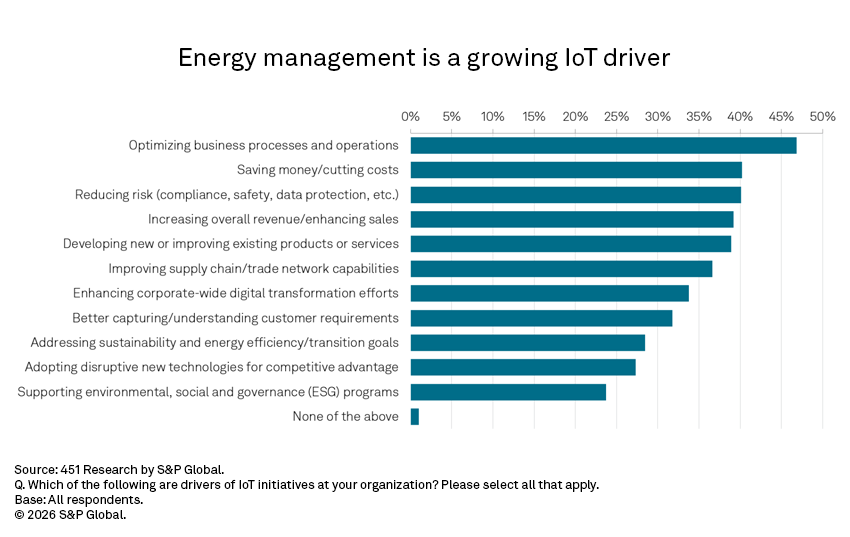
Operational pragmatism eclipses pure sustainability as the primary driver of industrial transformation. While addressing sustainability and energy transition goals is a primary OT/IoT driver for 28% of respondents, it significantly trails optimizing business processes (47%) and cutting costs (40%). This indicates that OT practitioners require technology investments to justify themselves through immediate efficiency gains rather than long-term ESG compliance alone.
Operational efficiency dominates energy investment motivations. Looking specifically at energy initiatives, more than half of respondents (55%) identify improving operational efficiency and productivity as their primary motivation. This exceeds reducing operational energy costs (47%), ensuring reliable supply (42%) and meeting decarbonization commitments (31%). Energy investments gain traction when linked directly to productivity.
Energy priorities vary sharply by industry. Oil and gas respondents are most likely to cite sustainability and energy transition goals as an OT/IoT driver (43%), followed by utilities (38%) and manufacturing (31%), with government organizations trailing significantly (19%). This demonstrates that energy-focused OT strategies advance fastest in sectors where energy represents a major cost input, an emissions obligation and a strategic business risk.
Utility mandates force early integration of sustainability performance metrics. Across the broader market, 26% of organizations track sustainability metrics or energy consumption measures as formal KPIs in their OT/IoT programs. However, utilities lead significantly at 41%, underscoring how sector-specific regulatory reporting obligations rapidly embed environmental measurement into operational governance.
AI value centers on immediate equipment health and operational visibility. When evaluating where AI will deliver maximum OT value, respondents prioritize the straightforward goals of improved monitoring and anomaly detection (44%) and operational efficiency optimization (43%) over an emphasis on autonomous operations. Manufacturing organizations are particularly hungry for AI-driven efficiency gains (47%) and predictive maintenance (48%), viewing AI as a tactical instrument for rooting out energy waste in real time.
Physical grid limitations are an operational roadblock, paving the way for behind-the-meter (BTM) infrastructure. Energy capacity limits are not a macroeconomic theory; 55% of respondents are actively experiencing delays in grid connections or capacity upgrades. This physical infrastructure bottleneck is forcing industrial enterprises to aggressively pivot toward localized, BTM generation and storage to maintain reliability and support growth initiatives. Although these technologies are in relatively early days, 38% of industrial enterprises plan to deploy advanced energy management systems (EMS) and 32% plan to deploy battery energy storage systems in the next three to five years, eclipsing other early-stage solutions such as virtual power plants (18%) and microgrids (13%).
On-site energy management challenges span integration, security and cost control. While industrial firms are looking beyond the grid for their power needs, BTM technologies pose significant challenges. Integration of EMS and building management systems is the top challenge, cited by 36% of respondents, followed by cybersecurity hardening across systems (27%) and achieving real-time control of BTM components (27%). New sources and strategies must incorporate the automation capabilities that industrial enterprises also seek from their grid connections.
The author used a proprietary S&P Global AI platform in the production of the report this blog post was based on. It was subsequently peer-reviewed, fact-checked and edited before publication.

IoT and the Rise of Smart Spaces
Want insights on IoT trends delivered to your inbox? Join the 451 Alliance.
