

Source: SinghaphanAllB/Moment via Getty images.
As organizations seek to process data closer to where it is generated — whether on factory floors, in vehicles or at retail locations — edge infrastructure is becoming essential for enabling real-time responsiveness, reducing latency and supporting emerging technologies such as AI and private 5G, according to a study conducted by 451 Research by S&P Global. Yet as adoption grows, so do the challenges: Fleet heterogeneity, tooling fragmentation and Day 2 operational constraints remain persistent barriers. These findings reflect a market in transition — one in which edge is moving from experimentation to execution and in which strategic clarity and robust management platforms will determine success.
The Take
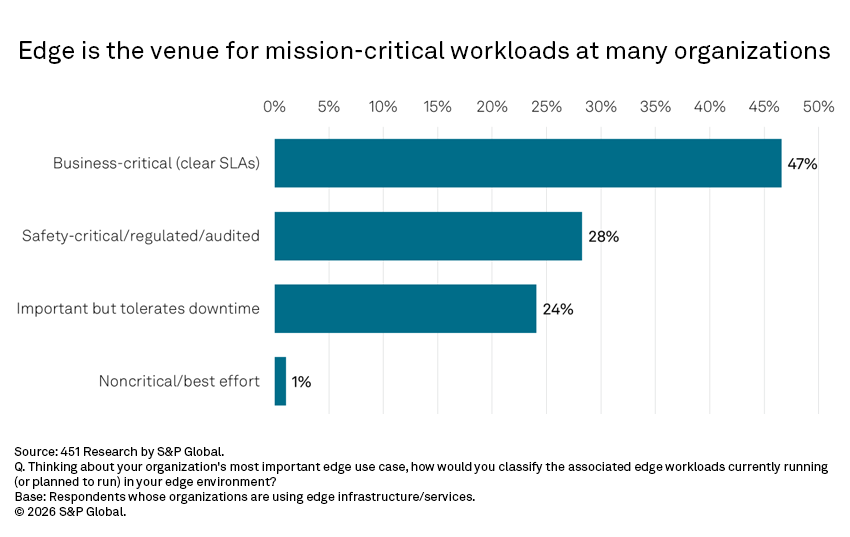
For technology vendors and platform providers, the 2026 edge landscape offers both opportunity and operational urgency. Organizations are running highly critical workloads at the edge, with nearly half classifying their primary edge application as business-critical, requiring vendors to move up the stack from pure hardware provision to comprehensive, secure and highly automated orchestration platforms. Platforms must embrace and manage fleet heterogeneity, as multivendor fleet management is a high priority for more than two-thirds of organizations, requiring control planes to be vendor-neutral or deeply supportive of non-original equipment manufacturer endpoints.
Vendors must also prepare for the AI inference wave by designing with the rollout, observability and life-cycle needs of distributed machine learning models in mind, since the vast majority of organizations expect AI to force material or transformative changes to their operations. Finally, as accountability for edge operations consolidates within central IT teams, vendors have a major opportunity to guide these organizations toward standardized central GitOps and continuous integration/continuous delivery (CI/CD) pipelines to drive operational efficiency and support robust physical and digital security.
Summary of findings
Organizational sentiment points to a rapidly maturing edge computing landscape, with infrastructure deployed across diverse environments and powered by both traditional and emerging technologies. AI is a key catalyst for investment, operations are centralizing, and workloads are shifting toward business-critical status, even as fleet diversity and site constraints remain operational bottlenecks.
Edge workloads are business-critical and high-stakes. Edge is no longer a venue for noncritical experiments. A striking 47% of organizations classify their most important edge workload as business-critical with clear service-level agreements (SLAs), while another 28% label it as safety-critical, regulated or audited. Only 24% of workloads are described as tolerating downtime, and a mere 1% are classified as noncritical or best-effort. This shift places premium demands on reliability, latency and platform stability.
AI inference and stream processing dominate workloads, driving major operational shifts. When looking at what runs on edge infrastructure, AI inference workloads, such as vision, anomaly detection and forecasting, lead at 45%, followed closely by data pipelines and stream processing at 42%.
This AI wave is poised to disrupt operations: 71% of organizations expect AI inference workloads to drive significant (49%) or transformative (22%) changes to their edge operations requirements over the next 24 months. Other notable workloads include embedded applications (35%), turnkey vendor-packaged appliances (33%), containerized microservices (30%) and virtual machine-based applications (30%).
Organizations demand a single control plane to manage heterogeneous multivendor fleets. Standardizing edge hardware remains a major hurdle. Only 27% of organizations describe their current edge fleet as mostly standardized with one primary OEM. Instead, the majority manage environments that are moderately mixed (52%) or highly mixed (21%). Consequently, 67% of organizations say that having an edge operations platform that can manage a multivendor fleet from a single control plane is highly important or mission-critical. When standardizing, the top required platform capabilities are security posture and policy enforcement (44%) and high availability and resilience patterns (42%).
Accountability is consolidating in central IT, but deployment pipelines remain fragmented. Accountability for ongoing, or Day 2, operations of edge environments is increasingly falling to central IT infrastructure and operations teams (46%), far outpacing dedicated security operations (18%) or line-of-business teams (11%). Despite this centralization, deployment practices are split: Only 29% of organizations use central CI/CD or GitOps with standardized pipelines today. Another 26% rely on vendor-managed updates, 23% use central pipelines but require significant site-by-site customization, and 17% still depend on mostly manual processes, including scripts, remote login and ad hoc updates.
The where and why of edge deployments are diverse and driven by local constraints. Organizational edge deployment is highly distributed, with organizations deploying applications and data to cloud regions (53%), on-device compute embedded in equipment (44%), on-premises organizational sites such as plants or warehouses (43%), and colocation data centers (23%). When deciding to deploy an application at the edge rather than in a centralized cloud or data center, the most significant drivers are data residency and regulatory requirements (37%), safety-critical operations (26%), and the performance requirements of AI inference (26%). Once deployed, these environments are most constrained by limited on-site IT support (40%), security patching requirements at distributed sites (39%), and safety-critical change control (38%).

IoT and the Rise of Smart Spaces
Want insights on IoT trends delivered to your inbox? Join the 451 Alliance.
